What is MQTT? A Complete Guide for Beginners
March 15, 2026
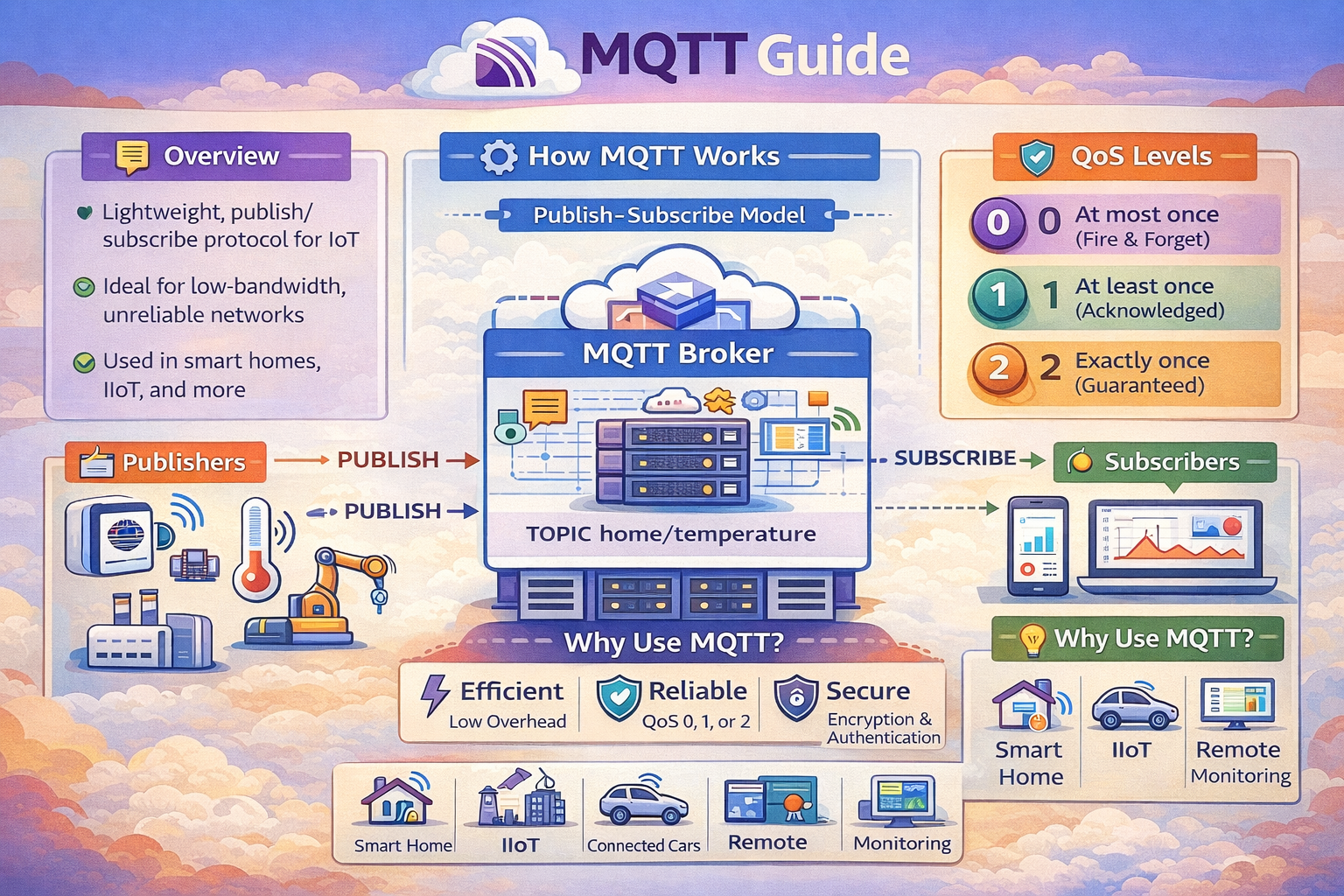
What is MQTT? A Complete Guide for Beginners
MQTT (Message Queuing Telemetry Transport) is a lightweight and efficient messaging protocol designed for the Internet of Things (IoT). It excels in scenarios where devices have limited resources and network bandwidth is at a premium. Originally developed by IBM and Arcom (now Eurotech) in 1999 to monitor oil pipelines over unreliable satellite networks, it has since become the globally recognized standard for real-time, reliable communication in a vast range of IoT and Industrial IoT (IIoT) applications.
This guide serves as a central pillar to understanding MQTT. We will cover the core concepts and provide links to deep-dive articles on specific sub-topics to give you a complete and comprehensive overview. While this guide provides a comprehensive overview, our new Definitive Guide to the MQTT Protocol offers an even deeper, more technical exploration for those looking to become true experts.
The Publish-Subscribe Architecture
Unlike the request-response model of HTTP, MQTT uses a publish-subscribe (pub-sub) pattern. This architecture brilliantly decouples the message sender (the publisher) from the receiver (the subscriber) using a central hub called a broker. Think of it like a subscription to a magazine: multiple authors (publishers) write articles and send them to the publishing house (the broker). The publishing house then distributes the magazines to all the paying readers (subscribers). The authors don't know who the readers are, and the readers don't know the authors. They are completely decoupled.
The core of this model involves three components: Publishers, Subscribers, and a Broker. Publishers are clients that send messages, subscribers are clients that receive them, and the broker is the intermediary that routes messages based on named channels called topics. This decoupling of space, time, and synchronization is what makes the system so flexible and scalable, and it's the foundational principle that allows a real-time MQTTfy dashboard to visualize data from thousands of devices simultaneously.
- To learn more about how clients, topics, and wildcards work, read our full guide on Understanding the MQTT Client Publish-Subscribe Model.
The Central Role of the MQTT Broker
The MQTT Broker is the heart and brain of the system. It is a central server responsible for receiving all messages from publishing clients and routing them to the correct subscribing clients. It manages client connections, handles security, and ensures reliable message delivery based on the rules of the protocol.
A professional broker's responsibilities are extensive:
- Connection Management: Manages the lifecycle of thousands or millions of persistent TCP connections from IoT devices.
- Authentication & Authorization: Verifies the identity of each connecting client and enforces rules (ACLs) about what data they are allowed to see or send.
- Message Routing: Efficiently filters and forwards millions of messages per second based on topic subscriptions.
- Session State: Maintains session information for clients, including their subscriptions and messages they missed while offline.
Choosing the right broker is a critical architectural decision. While an open-source broker like Mosquitto is excellent for learning, a production IIoT or commercial application demands a solution built for high availability, massive scalability, and operational simplicity. A managed, enterprise-grade broker like the Synapse MQTT broker offloads the immense operational burden of managing a distributed, fault-tolerant messaging system, allowing businesses to focus on creating value, not on managing infrastructure.
- For a comprehensive overview of broker functionalities, read our Deep Dive into the MQTT Broker.
- To explore cutting-edge broker technology, see our article on Next-Generation MQTT Brokers: Synapse.
Advanced MQTT Features for Robust Systems
Beyond the basic pub-sub flow, MQTT includes several powerful features designed to build reliable and resilient IoT applications.
- Persistent Sessions: When a client connects, it can request a "persistent session." If it disconnects and later reconnects, the broker remembers all its subscriptions and will even deliver any messages (with QoS > 0) that arrived while it was offline. This is crucial for devices on unreliable networks.
- Retained Messages: When a publisher sends a message with the "retain" flag, the broker keeps that message. The moment a new client subscribes to that topic, it immediately receives this "last known good value." This is perfect for status information, like the current state of a smart light (
onoroff). - Last Will and Testament (LWT): An LWT is a message that a client pre-registers with the broker. If the client disconnects ungracefully (e.g., loses power or crashes), the broker automatically publishes the LWT message to a specified topic. This allows other systems to immediately know that a device is offline, a critical feature for any serious monitoring system.
Quality of Service (QoS): Guaranteeing Message Delivery
To operate effectively on unreliable networks, MQTT provides three levels of Quality of Service (QoS). This is a crucial feature that allows developers to choose the right trade-off between performance and reliability for each specific message.
| QoS Level | Name | Description |
|---|---|---|
| 0 | At Most Once | The fastest level, but with no guarantee of delivery. "Fire and forget." |
| 1 | At Least Once | Guarantees the message will be delivered, but it might arrive more than once. The most common choice. |
| 2 | Exactly Once | The most reliable (and slowest) level, guaranteeing the message is delivered exactly once. Essential for billing or critical commands. |
- For a detailed explanation of how each level works and when to use them, check out MQTT QoS Explained (0, 1, & 2).
MQTT vs. HTTP: Why Choose MQTT for IoT?
While HTTP is the backbone of the web, it is often too heavy and inefficient for IoT. Its request-response, high-overhead nature is not suited for resource-constrained devices or real-time data streaming. MQTT was designed from the ground up to solve these problems. It uses a persistent connection, has a tiny message header (as small as 2 bytes), and its pub-sub model eliminates the need for constant polling, saving battery life and bandwidth by orders of magnitude.
- Read our detailed breakdown of the differences in our MQTT vs. HTTP for IoT article.
A Defense-in-Depth Approach to MQTT Security
For any real-world application, security is paramount. A comprehensive MQTT security strategy involves multiple layers, creating a defense-in-depth posture.
- Transport Layer Security (TLS/SSL): This is the foundation. Always use
MQTTS(MQTT over TLS) to encrypt all traffic between clients and the broker. This prevents eavesdropping and man-in-the-middle attacks. - Authentication: The broker must verify the identity of every client. While username/password is a basic option, the industry best practice is to use X.509 client certificates. Each device is provisioned with a unique certificate that acts as its non-forgeable identity.
- Authorization: Once a client is authenticated, authorization determines what it's allowed to do. Access Control Lists (ACLs) on the broker enforce the principle of least privilege. For example, an ACL can state that a specific temperature sensor is only allowed to publish to
sensors/temp/123and is not allowed to subscribe to any topics. This prevents a compromised device from wreaking havoc on the system.
Implementing this correctly is complex. A fully managed platform like MQTTfy handles these intricate security configurations, providing a secure-by-default environment for your IoT deployment.
- For a complete checklist on protecting your deployment, read our essential guide on Securing IoT Devices.
Core MQTT Use Cases & Applications
MQTT's flexibility has made it a cornerstone of modern IoT deployments across numerous industries.
1. Industrial IoT (IIoT) and SCADA
In the industrial world, MQTT acts as the nervous system for the smart factory. It bridges the critical gap between the legacy Operational Technology (OT) world of PLCs and machinery and the modern Information Technology (IT) world of cloud computing and analytics. An important extension for this space is Sparkplug B, which defines a standard topic namespace and payload format to ensure interoperability between industrial devices. In a typical IIoT setup, data flows from a machine to an edge gateway, which then publishes it securely via a Synapse MQTT broker to be consumed by both a local SCADA system and a cloud-based MQTTfy dashboard for enterprise-wide visibility.
- Learn more about its industrial impact in our guide on the Role of MQTT in IIoT and SCADA.
- Discover the industrial standard for interoperability with MQTT Sparkplug B Explained.
2. Smart Home Automation
From smart lighting to temperature sensors, MQTT allows various smart home devices from different manufacturers to communicate with a central hub and with each other seamlessly. Its low latency is perfect for responsive user experiences, like turning on a light from a mobile app with no perceptible delay.
- Explore practical examples in our guide on How to Use MQTT for Smart Home Automation.
3. Logistics and Fleet Management
For logistics companies, MQTT provides the real-time data stream needed to track thousands of vehicles and packages globally. GPS trackers on trucks publish their location every few seconds. Sensors inside refrigerated containers publish temperature data to ensure the cold chain is not broken. This data is visualized on a real-time map in a logistics monitoring dashboard, allowing dispatchers to optimize routes, predict arrival times, and respond to emergencies instantly.
4. Smart Cities
Cities use MQTT to manage public infrastructure at scale. Smart streetlights can report their status and energy consumption. Waste bins can signal when they are full and need to be collected. Environmental sensors can monitor air quality across the city. All this data, flowing through a central MQTT broker, allows city operators to manage resources more efficiently and create a better urban environment.
Getting Hands-On with MQTT
The best way to learn is by doing. You can get started with MQTT using affordable and powerful hardware.
- Set up your own central broker at home by following our guide to using a Raspberry Pi as an MQTT Broker.
- Learn to program a popular IoT microcontroller to send sensor data with our tutorial on Getting Started with ESP32 and MQTT.