The Role of MQTT in Modern IIoT and SCADA Systems
March 15, 2026
The Evolving Role of MQTT in IIoT and SCADA Systems
Supervisory Control and Data Acquisition (SCADA) systems have been the backbone of industrial control for decades. Traditionally, these systems relied on proprietary, poll-response protocols. While robust, they face challenges in the era of the Industrial Internet of Things (IIoT), which demands connectivity, scalability, and security.
MQTT, with its modern publish-subscribe architecture, has emerged as a critical technology for bridging the gap between legacy Operational Technology (OT) and modern Information Technology (IT) infrastructure.
Why MQTT is the Perfect Bridge for IIoT
Traditional industrial protocols are often heavy or based on an inefficient polling model. MQTT, with its lightweight and publish-subscribe model, solves many of these problems.
| Feature | Industrial Benefit |
|---|---|
| Lightweight Header | Minimizes bandwidth usage on factory networks. |
| Pub/Sub Model | A single PLC can publish its data once, and it can be consumed by multiple systems without extra load on the PLC. |
| Report-by-Exception | Devices only publish messages when their state changes, drastically reducing network traffic. |
| State Awareness | The Last Will and Testament (LWT) feature immediately notifies the system if a critical machine goes offline. |
Architecture: Integrating MQTT with SCADA
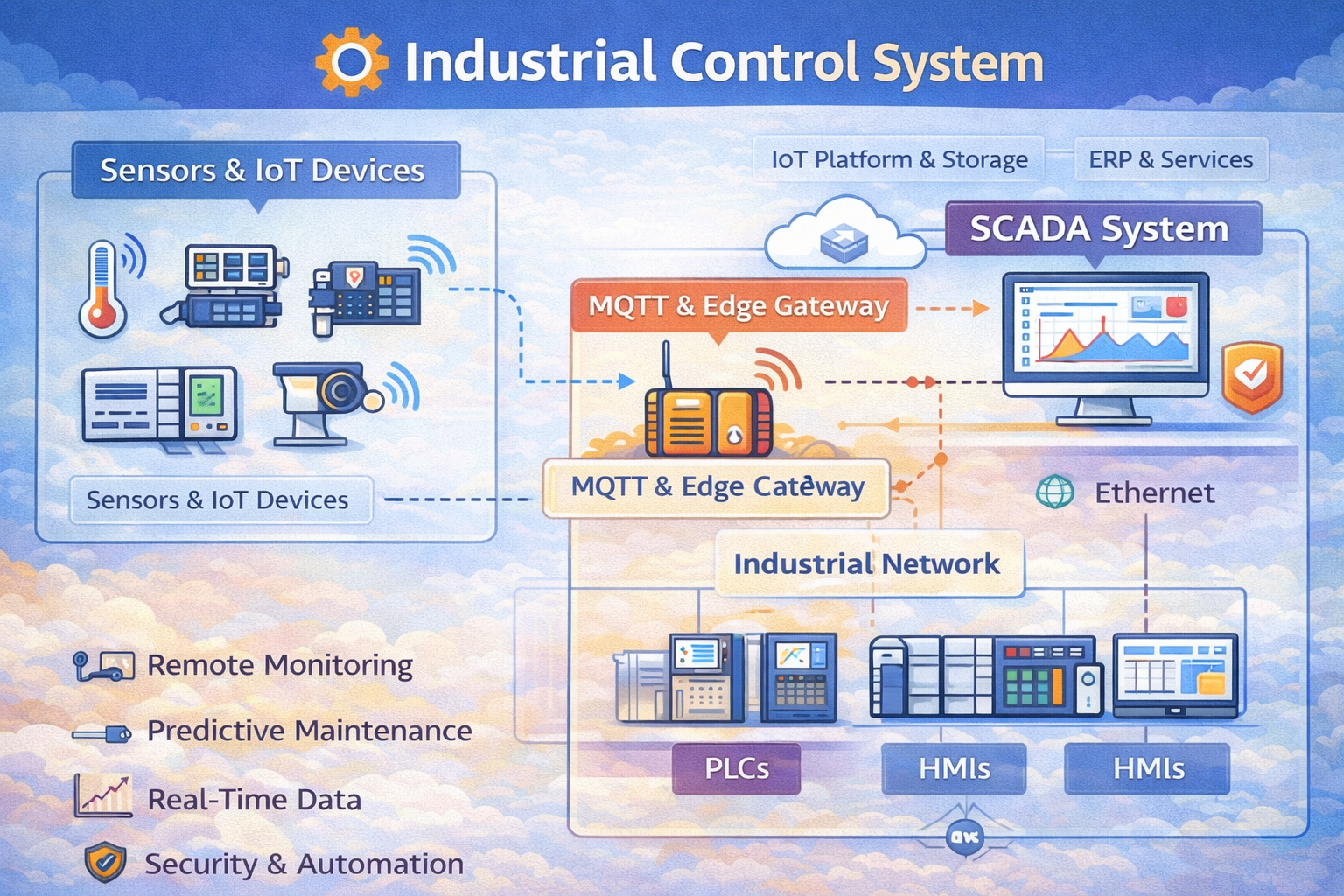
A common architecture involves using an MQTT broker as a central data bus. An Edge Gateway on the factory floor subscribes to sensor data and then publishes it to the central broker.
The Next Step: MQTT Sparkplug B
To further enhance MQTT for industrial use, the Sparkplug B specification was created. It provides a standardized topic namespace and payload structure, ensuring interoperability between devices and applications from different vendors.
Modernizing SCADA with a Real-Time MQTT Dashboard
The traditional face of SCADA is the Human-Machine Interface (HMI)—a static screen in a control room displaying a P&ID-style diagram. While effective for direct machine control, these legacy HMIs are often isolated, inflexible, and provide little business context. The modern approach is to augment or replace these screens with a centralized, web-based MQTTfy dashboard, transforming raw operational data into enterprise-wide business intelligence.
This shift from a rigid HMI to a dynamic IIoT dashboard offers several profound advantages:
- Unified Visibility: A traditional SCADA HMI is often tied to a specific location or vendor's system. With a centralized dashboard, you can create a single pane of glass that visualizes data from multiple plants, production lines, and even different legacy SCADA systems, all in one place.
- Accessibility and Mobility: Operators and managers are no longer chained to a control room. A responsive, web-based dashboard allows them to securely monitor operations from any device—a desktop in the office, a tablet on the factory floor, or a smartphone during a field visit.
- From Operational Data to Business KPIs: While an HMI shows a pump's pressure, a modern dashboard can combine that operational data with information from IT systems (like an ERP or CMMS) to display business-level Key Performance Indicators (KPIs). You can visualize Overall Equipment Effectiveness (OEE), energy cost per unit produced, or the direct impact of downtime on production orders—metrics that a traditional HMI cannot comprehend.
- Democratization of Data: A real-time SCADA dashboard makes operational data accessible to a wider range of stakeholders. Engineers, data analysts, and business executives can all view the data relevant to their roles, fostering a more collaborative and data-driven culture.
Building an effective enterprise-grade SCADA dashboard involves more than just plotting data. It requires features like role-based access control (ensuring an operator can't change a screen designed for a plant manager), integrated alerting that can push notifications to email or Slack, and the ability to combine real-time data with historical trends for root cause analysis.
Deep Dive: How MQTT Solves Core SCADA Challenges
To truly appreciate the paradigm shift MQTT introduces, we must look closer at the fundamental problems with traditional poll-response architectures and how MQTT elegantly solves them.
1. The Inefficiency of Polling
The Old Way: A traditional SCADA master continuously polls every single device: "What is your value? What is your value? What is your value?" This happens thousands of times a minute, even if the values haven't changed. This creates a massive amount of unnecessary network traffic and places a constant processing load on the PLCs and RTUs.
The MQTT Way (Report-by-Exception): MQTT clients publish data only when a value changes. A tank level sensor doesn't send its reading every second; it sends a message only when the level changes by a significant amount. This "report-by-exception" model can reduce network traffic by over 90%, freeing up bandwidth and allowing the network to scale to thousands more devices without congestion.
2. The Security Risk of Inbound Ports
The Old Way: For a SCADA master to poll a device in a secure OT network, a firewall rule must be created to allow inbound connections. Every open inbound port is a potential attack vector that a malicious actor on the IT network could exploit to try and gain access to the critical OT environment.
The MQTT Way (Outbound Connections): MQTT clients in the OT network initiate a secure, outbound connection to the MQTT broker in the IT network or cloud. No inbound ports need to be opened into the secure OT zone. This is a fundamentally more secure architecture, as the OT network is completely isolated from unsolicited external connection attempts.
3. The Brittleness of Proprietary Protocols
The Old Way: Vendor A's SCADA system speaks Vendor A's protocol. Vendor B's PLC speaks Vendor B's protocol. Integrating them requires expensive, complex, and custom-written drivers or OPC servers. This vendor lock-in stifles innovation and makes it difficult to adopt best-in-class solutions.
The MQTT Way (Decoupled Middleware): MQTT acts as a universal translator. An edge gateway can talk to any vendor's PLC, collect the data, and publish it to the broker in a standardized format. The SCADA system, the data historian, and the MQTTfy dashboard simply subscribe to the data from the broker. They don't need to know or care about the underlying hardware's protocol. This decoupling provides immense flexibility, allowing you to swap out field devices or backend applications without breaking the entire system.
The Power of Sparkplug B for SCADA 2.0
While MQTT provides the ideal transport mechanism, the base protocol doesn't define the structure of the topic or the payload. This can lead to a "wild west" scenario where every device publishes data in a different format, creating integration challenges on the backend.
This is the problem that MQTT Sparkplug B was created to solve. Sparkplug is a specification that sits on top of MQTT and defines a standardized way for industrial devices to communicate. It brings three critical benefits to SCADA systems:
-
Standardized Topic Namespace: Sparkplug defines a strict topic structure:
spBv1.0/group_id/message_type/node_id/[device_id]. This brings order and predictability to your topic tree, making it easy to understand the origin and purpose of any message. -
Standardized Payload Format: Sparkplug payloads are encoded using Google Protocol Buffers, a highly efficient binary format. It defines standard messages for device birth, death, and data, ensuring that all Sparkplug-compliant devices and applications speak the same language.
-
State Management and Auto-Discovery: This is Sparkplug's killer feature for SCADA. When a Sparkplug-enabled device connects, it publishes a "Birth Certificate" message containing metadata about all its tags (data points). A modern SCADA system or an advanced MQTTfy dashboard can subscribe to these birth certificates and automatically discover all devices, their tags, their data types, and their engineering units without any manual configuration. This dramatically simplifies system setup and maintenance.
By combining the efficiency of MQTT with the standardization of Sparkplug B, organizations can build truly interoperable, plug-and-play IIoT and SCADA systems.
Building a Future-Proof IIoT Platform with MQTTfy
As industrial operations embrace digital transformation, the need for a comprehensive platform that can manage the entire data lifecycle becomes paramount. A successful IIoT strategy requires more than just a broker; it needs a complete, integrated platform like MQTTfy. Here's how such a platform addresses the full spectrum of SCADA and IIoT needs:
-
A Managed, High-Availability Broker: At the core is a broker like the Synapse MQTT broker. Instead of spending precious engineering resources on managing, scaling, and securing an open-source broker, a managed platform provides a clustered, fault-tolerant broker as a service, guaranteeing uptime and performance.
-
Integrated Data Visualization: The platform includes a powerful, user-friendly visualization tool—the MQTTfy dashboard. This eliminates the need to purchase and integrate a separate HMI or dashboarding tool. It provides a seamless experience where data ingested by the broker is immediately available for visualization, with features specifically designed for industrial use cases.
-
Agentic Intelligence at the Core: Modern platforms are moving beyond simple message passing. The agentic Synapse broker allows you to embed logic directly into the data stream. For a SCADA system, this is revolutionary. You could create an agent that:
- Validates commands: Before a
STOPcommand from a dashboard is sent to a physical PLC, an agent could first check the status of three other related machines to prevent a dangerous cascading failure. - Enriches data: When a pressure reading arrives, an agent could call an external API to get the current price of the material in that pipe and add it to the message payload, providing immediate financial context to operational data.
- Performs complex alerting: An agent could be configured to detect subtle, multi-variable patterns that precede a failure—something a simple threshold alert could never catch—and trigger a predictive maintenance workflow.
- Validates commands: Before a
By choosing a complete platform, you are not just modernizing your SCADA system; you are building a foundation for a truly data-driven, intelligent industrial operation. The ability to create a customizable mobile-friendly SCADA dashboard and integrate it with an intelligent broker is the key to unlocking the full potential of your IIoT data.