A Deep Dive into the MQTT Broker
February 24, 2026
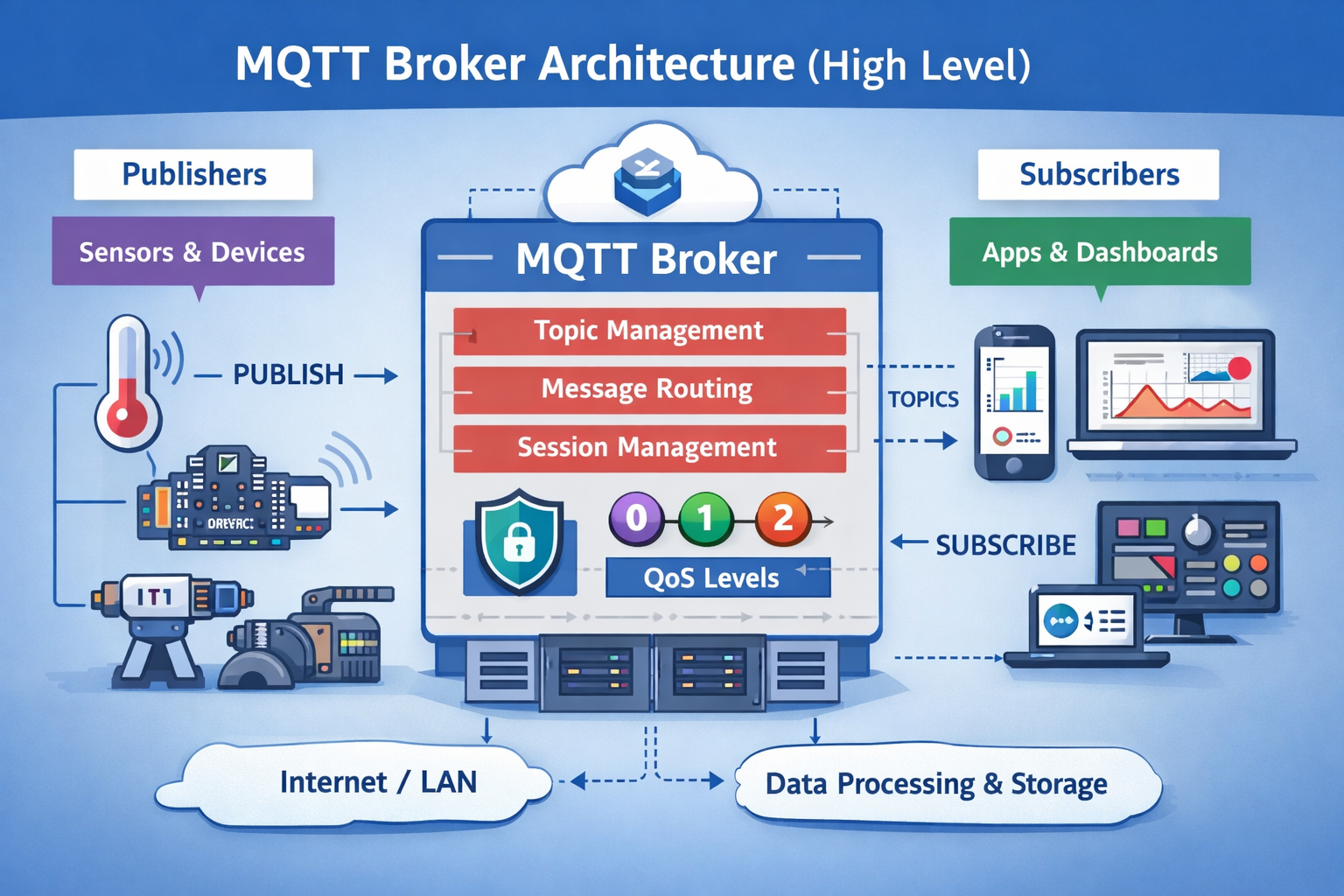
A Deep Dive into the MQTT Broker
In the world of IoT, the MQTT broker is the central hub, the post office, and the air traffic controller all in one. It is a server application at the heart of the MQTT protocol, responsible for orchestrating the flow of messages between clients. Understanding its core functions is key to building a robust and scalable IoT system. This article focuses on the broker itself. To understand how the broker fits into the complete MQTT ecosystem, including clients, security, and advanced features, please refer to our new Definitive Guide to the MQTT Protocol.
1. Core Responsibility: Message Routing
The fundamental job of the broker is to decouple publishers from subscribers. When a device publishes a message to a specific "topic," it sends it to the broker. The broker then forwards the message to all clients that have subscribed to that topic. The publisher and subscribers don't know each other; they only know the broker.
This architecture makes MQTT incredibly flexible. New devices can be added without reconfiguring the entire system. All they need is the broker's address and the relevant topics.
Key Features Managed by the Broker
1. Quality of Service (QoS)
MQTT defines three levels of Quality of Service (QoS) to ensure message reliability, and the broker is responsible for enforcing them.
- QoS 0 (At most once): Fastest but least reliable. The broker sends the message and forgets about it.
- QoS 1 (At least once): Guarantees delivery at least once, but can result in duplicates.
- QoS 2 (Exactly once): The most reliable but slowest, ensuring the message is delivered exactly once.
A high-performance broker can manage thousands of these stateful message flows simultaneously.
2. Topic Filtering and Wildcards
Topics are structured hierarchically (e.g., home/livingroom/temperature), allowing for powerful filtering with wildcards.
| Wildcard | Name | Description |
|---|---|---|
+ | Single-Level | Matches one level. home/+/temp matches home/room1/temp. |
# | Multi-Level | Matches many levels at the end. home/# matches everything under home. |
The broker uses these to efficiently route messages to the correct subscribers.
3. State Management: Retained Messages
When a message is published with the "retain" flag, the broker stores it. Any new client that subscribes to that topic will instantly receive this last-known value. This is perfect for status information, like a device being online.
4. Connection State: Last Will and Testament (LWT)
A client can register an LWT message with the broker upon connection. If the client disconnects ungracefully (e.g., power loss), the broker automatically publishes this LWT message to a specified topic. This is a vital mechanism for device status monitoring in smart home and industrial (IIoT) applications.
5. Popular MQTT Brokers
| Broker | Best For |
|---|---|
| Mosquitto | Lightweight, ideal for development and local hosting on a Raspberry Pi. |
| VerneMQ/EMQX | Scalable, clustered brokers designed for large, enterprise-grade deployments. |
For complex industrial messaging, standards like Sparkplug B build on top of MQTT to provide even greater structure and interoperability.
6. How an MQTT Broker Works Internally
To truly understand the power of an MQTT broker, we need to look beyond basic message routing and explore its internal architecture. A modern MQTT broker is designed for low latency, high concurrency, and efficient memory usage.
At a high level, a broker performs the following internal steps:
- Accept TCP/WebSocket Connections
- Authenticate Clients
- Authorize Topic Access
- Process Publish Packets
- Match Subscriptions
- Dispatch Messages
- Manage Session State
A high-performance MQTT message broker uses event-driven architecture (often based on epoll/kqueue) to handle thousands or even millions of concurrent MQTT client connections.
Broker Processing Flow
This efficient handshake mechanism is one reason why MQTT is considered one of the best lightweight messaging protocols for IoT.
7. MQTT Broker vs MQTT Client: Clear Differences
Many beginners confuse the MQTT broker with the MQTT client. Understanding their difference is critical when designing IoT architecture.
| Component | Role | Examples |
|---|---|---|
| MQTT Broker | Central server that routes messages | Mosquitto, EMQX, HiveMQ |
| MQTT Client | Device or application that publishes/subscribes | ESP32, Node.js app, Android app |
An MQTT client can act as:
- A publisher
- A subscriber
- Or both simultaneously
For example:
- An ESP32 temperature sensor → Publishes data
- A dashboard web app → Subscribes to temperature topic
- A mobile app → Publishes control commands
This decoupled publish-subscribe model is what makes MQTT scalable for smart home automation, industrial IoT dashboards, and real-time telemetry systems.
8. Best MQTT Broker Options (2026 Comparison)
Choosing the best MQTT broker depends on scale, security requirements, and deployment environment.
1. Mosquitto (Lightweight & Open Source)
Best for:
- Raspberry Pi MQTT broker setup
- Local development
- Small IoT projects
- Edge deployments
Pros:
- Very lightweight
- Easy to install
- Open-source
- Minimal resource usage
Cons:
- Limited clustering support
- Basic enterprise features
2. EMQX (High-Performance & Scalable)
Best for:
- Large-scale IoT deployments
- Multi-million device connections
- Enterprise systems
Pros:
- Horizontal clustering
- High throughput
- Rule engine
- Web dashboard
- Built-in authentication plugins
EMQX is often considered one of the best scalable MQTT brokers for industrial IoT.
3. HiveMQ (Enterprise Grade)
Best for:
- Enterprise environments
- Mission-critical deployments
- Financial and industrial applications
Pros:
- Full MQTT 5 support
- Enterprise security
- Advanced monitoring
- Professional support
4. Cloud MQTT Brokers
Examples:
- AWS IoT Core
- Azure IoT Hub
- Google Cloud IoT
Best for:
- Global deployments
- Serverless architecture
- Auto-scaling needs
Cloud MQTT broker solutions eliminate infrastructure management but introduce operational costs.
9. MQTT Broker Deployment Architectures
An MQTT broker can be deployed in several ways:
1. Single Node Deployment
- Simple setup
- Good for testing
- Single point of failure
2. Clustered MQTT Broker Setup
- Multiple broker nodes
- Load balancing
- High availability
- Failover support
3. Edge + Cloud Hybrid Architecture
- Local broker at edge (factory/home)
- Cloud broker for analytics
- Reduced latency
- Bandwidth optimization
This hybrid architecture is becoming popular in IIoT and smart manufacturing environments.
10. MQTT Security Best Practices
Security is critical in IoT systems. A secure MQTT broker setup should include:
1. TLS Encryption
Always use mqtts:// instead of plain mqtt://.
2. Strong Authentication
- Username & password
- JWT tokens
- X.509 certificates
- OAuth integration
3. Topic-Level Authorization (ACL)
Example:
- Device A → Can publish to
factory/machine1/data - Device A → Cannot subscribe to
factory/machine2/data
4. Rate Limiting & DoS Protection
Prevents malicious clients from flooding the broker.
5. Secure WebSocket MQTT
For browser dashboards, use secure WebSocket connections (wss://).
11. MQTT 5.0 Enhancements in Modern Brokers
The MQTT 5 protocol introduced powerful improvements:
- User properties (metadata in messages)
- Reason codes
- Shared subscriptions
- Message expiry interval
- Flow control
- Negative acknowledgments
Shared subscriptions ($share/group/topic) allow load balancing across multiple subscribers — ideal for scalable backend processing systems.
Modern MQTT brokers fully supporting MQTT 5 offer better observability and debugging capabilities.
12. Performance Optimization for MQTT Brokers
To achieve high performance:
- Use persistent sessions wisely
- Optimize QoS levels
- Avoid deep wildcard subscriptions in high-volume systems
- Use retained messages strategically
- Configure message size limits
- Enable message batching where supported
For ultra-low latency IoT systems:
- Use QoS 0 for telemetry
- Use QoS 1 for important updates
- Avoid QoS 2 unless strictly required
13. MQTT Broker in Smart Home Systems
In smart homes, the MQTT broker connects:
- Smart switches
- Sensors
- Cameras
- HVAC systems
- Energy meters
Example topic structure:
home/livingroom/light/status home/livingroom/light/command home/kitchen/temperature home/main_door/lock/status
With retained messages and LWT, dashboards instantly show:
- Device online/offline state
- Current temperature
- Last known light state
This is why MQTT is one of the best protocols for home automation platforms.
14. MQTT Broker in Industrial IoT (IIoT)
In industrial automation, MQTT brokers enable:
- PLC communication
- SCADA integration
- Real-time machine monitoring
- Predictive maintenance
- Energy optimization
Typical IIoT use cases:
- Factory machine data streaming
- Production line analytics
- Remote diagnostics
- Alarm notifications
- Edge gateway communication
When combined with structured topic namespaces and standards like Sparkplug B, the broker becomes the backbone of industrial data infrastructure.
15. MQTT Broker Monitoring & Observability
A production-grade MQTT broker must be monitored.
Key metrics to track:
- Connected clients
- Message throughput (msg/sec)
- Subscription count
- Memory usage
- CPU usage
- Dropped messages
- Latency
Enterprise MQTT brokers provide dashboards and Prometheus integration for real-time monitoring.
Without proper observability, diagnosing MQTT performance issues becomes difficult at scale.
16. Common MQTT Broker Mistakes to Avoid
- Using QoS 2 unnecessarily
- Not enabling authentication
- Poor topic hierarchy design
- Overusing multi-level wildcards
- Not configuring message retention properly
- Ignoring persistent session cleanup
- No backup strategy for broker data
Proper broker configuration ensures long-term scalability and reliability.
17. Future of MQTT Brokers
The future of MQTT broker technology includes:
- AI-powered anomaly detection
- Built-in stream processing
- Serverless MQTT brokers
- Edge-native brokers
- Zero-trust security architecture
- Native digital twin synchronization
As IoT ecosystems expand, the MQTT broker will evolve from a simple message router into a smart data orchestration engine.
Conclusion
The MQTT broker is far more than a simple message forwarder. It's a sophisticated engine that manages state, ensures reliability, and provides scalability. As IoT evolves, next-generation brokers are becoming even more powerful, adding new layers of intelligence.