The Next Generation of MQTT Brokers: Agentic Architecture with Synapse
March 15, 2026
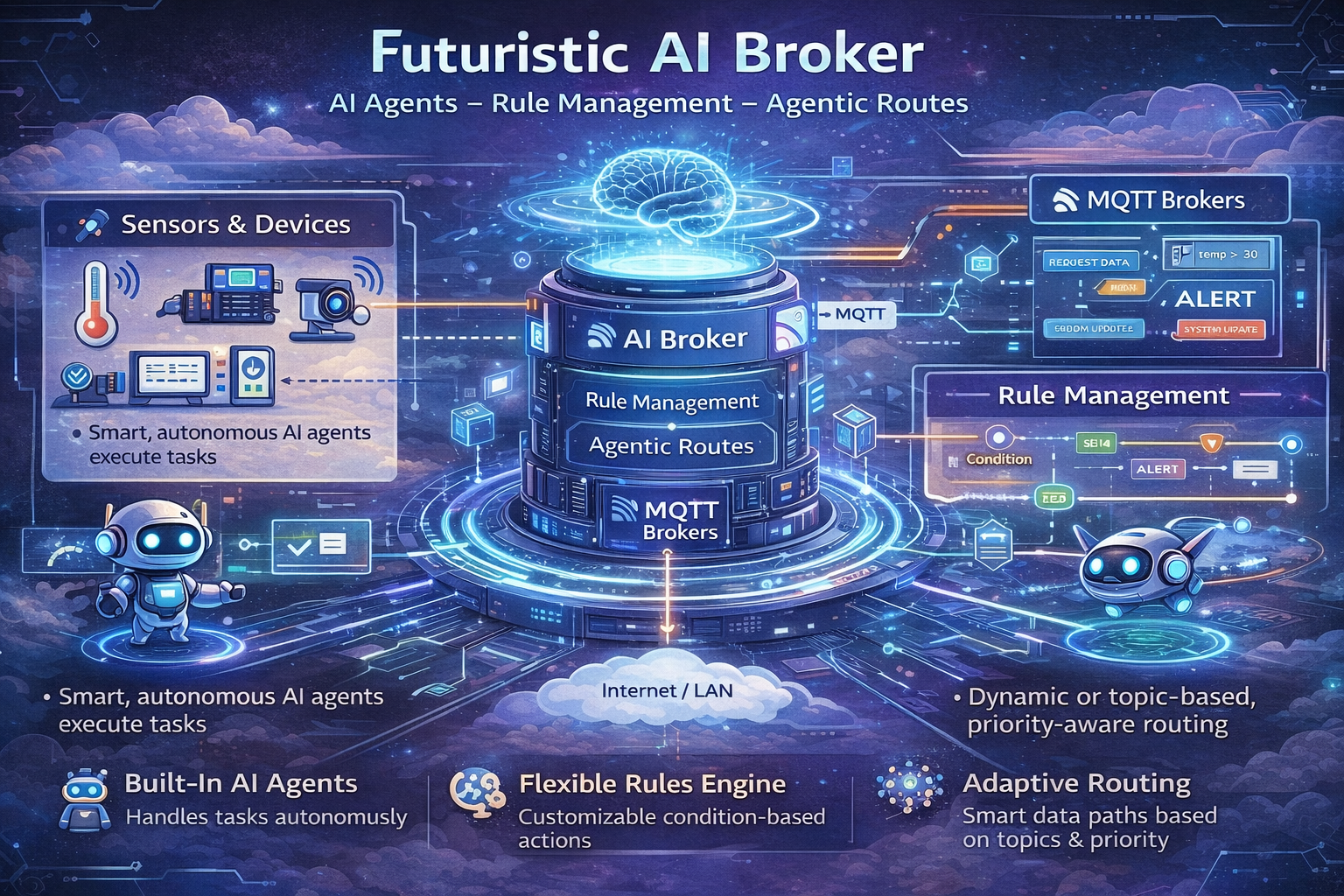
The Next Generation of MQTT Brokers: Agentic Architecture
For years, the MQTT broker has served as a simple, reliable message bus: a post office that dutifully forwards messages from publishers to subscribers based on topic names. While effective, this model is passive. The broker has no understanding of the content of the messages it handles. As IoT systems become more complex, there is a growing need for intelligence within the messaging layer itself.
This need gives rise to the next generation of MQTT infrastructure: the Agentic Broker. An agentic broker, like the upcoming MQTTfy Synapse, embeds an AI agent core directly into the message processing pipeline, transforming it from a passive router into an active, intelligent hub.
From Passive Router to Intelligent Hub
A traditional MQTT broker's logic is simple: IF topic matches subscription, THEN forward message. An agentic broker introduces a powerful new paradigm.
The workflow becomes:
- Ingest: The broker receives a message on a topic.
- Trigger: Instead of immediately looking for subscribers, the broker triggers a dedicated AI agent associated with that topic or data source.
- Analyze & Act: The AI agent analyzes the message's payload. Based on its pre-defined goal and the tools at its disposal, it can perform complex actions:
- Data Validation: Check if the payload conforms to a required schema. If not, it can reject the message or route it to an error topic.
- Contextual Enrichment: Use a "tool" to call an external API. For example, it could take a GPS coordinate, call a reverse-geocoding API to get a street address, and append that address to the message payload.
- AI-Powered Analysis: Use a "tool" to pass the data to a larger language model (LLM) or a specialized machine learning model for anomaly detection, classification, or prediction.
- Intelligent Routing: Based on the outcome of its analysis, the agent makes a routing decision. A message with an anomalous reading might be published to
alerts/critical, while normal readings go totelemetry/standard.
Use Cases for an Agentic Broker
The possibilities are transformative.
1. Broker-Level Anomaly Detection: An AI agent within the broker can maintain a running average of sensor values. If a new message comes in that is a statistical outlier, the agent can reroute it to a high-priority alerts/anomaly topic or trigger an immediate action, even before the data hits a database.
2. Dynamic Data Transformation: Imagine a US-based application and a Europe-based application are both subscribed to a temperature sensor that publishes in Celsius. The agentic broker can detect which client is which and automatically transform the payload to Fahrenheit for the US client while leaving it as Celsius for the European one.
3. Centralized Business Logic: In the smart factory example above, the intelligence is centralized. The subscribing applications (like a dashboard) don't need complex logic; they simply subscribe to the alerts/# topic and display the pre-processed, actionable information provided by the agent. This dramatically simplifies client applications and reduces maintenance.
Key Advantages of Agentic Architecture
| Feature | Description | Benefit |
|---|---|---|
| In-Stream Processing | Logic is applied as data flows through the broker, not after it reaches its destination. | Reduces latency, centralizes business logic, and ensures data is validated and enriched at the source. |
| Decoupled Intelligence | The data-producing device is dumb; the intelligence resides in the broker. | Devices can be simple and low-cost. Business logic can be updated in the broker without touching device firmware. |
| Tool-Based Extensibility | AI agents can be granted "tools" to interact with any external system via API or database query. | Infinitely extensible. The broker can become the central nervous system connecting OT and IT systems. |
| Stateful Routing | Routing decisions can be based on historical data or external state, not just the current message. | Enables more complex and context-aware automations, moving closer to true autonomous operations. |
The Core Architecture of an Agentic MQTT Broker
To deliver these advanced capabilities, a next-generation MQTT broker like the Synapse broker requires a sophisticated internal architecture that extends far beyond the traditional publish-subscribe model. This architecture is designed for performance, security, and scalability, ensuring that intelligence doesn't come at the cost of reliability. Let's explore the foundational pillars of this design.
1. The Multi-Stage Message Pipeline
Unlike a traditional broker that has a single-stage routing process, an agentic broker employs a multi-stage pipeline for every message it handles. This pipeline provides hooks for the agentic core to interact with the message at various points.
- Ingestion Stage: The message is received from the device, and its basic MQTT properties (QoS, topic, retain flag) are parsed. The broker immediately handles the low-level MQTT acknowledgments (like
PUBACKfor QoS 1) at this stage to free up the client. - Triggering & Analysis Stage: The message is presented to the Agent Core. The core determines if any agents are subscribed to the message's topic. If so, it invokes the appropriate agent, providing the message payload and metadata as context. This is where the primary analysis, enrichment, and tool usage occur.
- Routing & Dispatch Stage: After the agent has processed the message (or if no agent was triggered), the message is passed to the routing engine. The routing engine now has the original message and potentially a modified or new message from the agent. It makes the final decision on which message to send to which subscribers. This stage also handles QoS promotion or demotion based on subscriber requirements.
- Egress Stage: The final message is delivered to the subscribing clients, with all application-level logic now complete.
This pipelined approach allows for a clean separation of concerns, enabling high-speed routing for non-agentic topics while providing a structured environment for complex processing on others. It's a key component of what makes a modern MQTT broker so powerful.
2. The Agent Core and Secure Sandbox
The heart of the system is the Agent Core. This isn't a single monolithic program but a multi-tenant execution environment. Each configured agent runs in a secure, isolated sandbox.
This sandboxing is critical for several reasons:
- Security: An agent, especially one using custom scripts or third-party tools, must not be able to interfere with the broker's core operations or access data from other agents. The sandbox restricts an agent's access to memory, CPU, and network resources.
- Stability: If an agent enters an infinite loop or crashes due to a bug in a custom script or a faulty API response, the sandbox contains the failure. The broker can terminate the misbehaving agent and route the message to an error topic without affecting the stability of the entire system.
- Resource Management: The sandbox allows the broker to enforce strict resource quotas (e.g., maximum CPU time, memory usage, number of outbound API calls per minute). This prevents a single, poorly configured agent from consuming all the server's resources and degrading performance for all clients.
This architecture turns the broker into a true microservices-style platform, where each agent acts as an independent, secure, and resource-aware service. Learn more about our approach on our home page.
3. The Extensible Tool Library
Agents are only as powerful as the tools they can use. A key architectural component is the Extensible Tool Library. This is a plug-and-play system where new capabilities can be added to the broker without requiring a core software update. Tools fall into several categories:
- Protocol Adapters: Tools for communicating with other systems (e.g., making an HTTPS API call, querying a SQL database, or sending a message to a Kafka topic).
- Data Parsers: Tools for understanding different data formats (e.g., parsing a complex binary payload from a legacy industrial machine or converting XML to JSON).
- AI & Machine Learning Models: Tools that provide access to pre-trained models for tasks like natural language processing, image recognition (on image data sent over MQTT), or anomaly detection.
- Custom Scripts: A tool that allows developers to write small snippets of code (e.g., in Python or JavaScript) to perform custom data manipulations that are too specific for a generic tool.
The ability to add and configure these tools is what gives an agentic broker its immense flexibility, allowing it to become the central integration hub in a complex IIoT environment.
Advanced Security in Next-Generation Brokers: Beyond TLS and ACLs
While traditional MQTT security relies on TLS for encryption and Access Control Lists (ACLs) for authorization, this is often insufficient for sophisticated IoT deployments. A traditional broker, once it authenticates a device, blindly trusts the payload it sends. An agentic broker introduces a new, proactive layer of security: Payload-Aware Security.
Deep Packet Inspection (DPI) for MQTT
Because an agentic broker can inspect the content of messages, it can act as a sophisticated, application-layer firewall. Agents can be configured to perform Deep Packet Inspection on MQTT payloads, providing several advanced security benefits:
- Schema Validation: For a given topic, you can define an expected JSON schema or data format. If a device sends a message that doesn't conform to the schema (e.g., has extra fields, wrong data types), the agent can immediately reject it. This prevents malformed data from ever reaching backend applications and can block certain types of injection attacks.
- Content Filtering: An agent can scan payloads for malicious content. For example, it could check for SQL injection strings in a message destined for a database logging tool or look for known attack signatures in binary data.
- Behavioral Anomaly Detection: A security-focused agent can monitor the behavior of a specific client. If a sensor that normally sends a 10-byte payload every minute suddenly sends a 10-kilobyte payload, the agent can flag this as suspicious. If a device tries to publish to topics it has never used before, the agent can temporarily revoke its permissions and raise a security alert. This moves beyond static ACLs to dynamic, behavior-based authorization.
This DPI capability transforms the MQTT broker from a passive message forwarder into an active Intrusion Detection and Prevention System (IDPS) tailored for IoT protocols. The Synapse broker is built with this philosophy at its core.
Scalability and High Availability in Agentic Systems
A common concern with adding more processing into the broker is the impact on performance and scalability. Next-generation brokers are designed from the ground up to be distributed systems, ensuring that intelligence doesn't create a single point of failure or a performance bottleneck.
Clustering in an agentic broker is far more complex than in a traditional one. It involves not just replicating messages but also managing the state and deployment of the agents themselves.
- Stateless Agent Design: Agents are designed to be stateless wherever possible. All the information they need to process a message is either contained within the message payload itself or retrieved from an external tool (like a database). This means any agent can run on any node in the cluster, allowing for seamless load balancing.
- Distributed State Management: For agents that require state (e.g., to calculate a running average), that state is not stored on a single broker node. Instead, it's held in a distributed, high-availability data store (like etcd or a Redis cluster) that is shared across the entire broker cluster. If a broker node fails, another node can instantly take over processing for the agent, accessing the last known state from the distributed store.
- Geo-Distribution and Edge Processing: An agentic architecture allows for intelligent tiered deployments. You can have a large-scale Synapse broker cluster in the cloud performing heavy-duty analytics, with smaller, lightweight agentic brokers at the edge (e.g., in a factory). The edge agents can perform initial data filtering, local real-time control, and anomaly detection. They then only forward high-value, summarized, or anomalous data to the central cloud cluster. This hybrid approach dramatically reduces cloud ingress costs and improves the resilience of the entire system.
By building on modern distributed systems principles, a next-generation MQTT broker can provide intelligent, in-stream processing that scales to millions of devices and billions of messages, a core tenet of our philosophy, which you can read about on our home page.
The shift towards agentic brokers represents a fundamental change in how we think about messaging infrastructure. It's no longer just about delivering data, but about understanding, enriching, and acting on that data in real-time. Platforms like the Synapse MQTT broker are paving the way for more intelligent, responsive, and autonomous systems in the evolving landscape of IoT and IIoT.