An Introduction to MQTT
March 15, 2026
What is MQTT?
This article provides a foundational introduction to MQTT. For a complete, 5000-word technical deep dive covering every aspect of the protocol, from architecture to advanced security and MQTTv5, please see our new Definitive Guide to the MQTT Protocol.
MQTT, which stands for Message Queuing Telemetry Transport, is a lightweight and efficient publish-subscribe network protocol designed for constrained devices and low-bandwidth, high-latency, or unreliable networks. It is the de-facto standard for messaging in the Internet of Things (IoT).
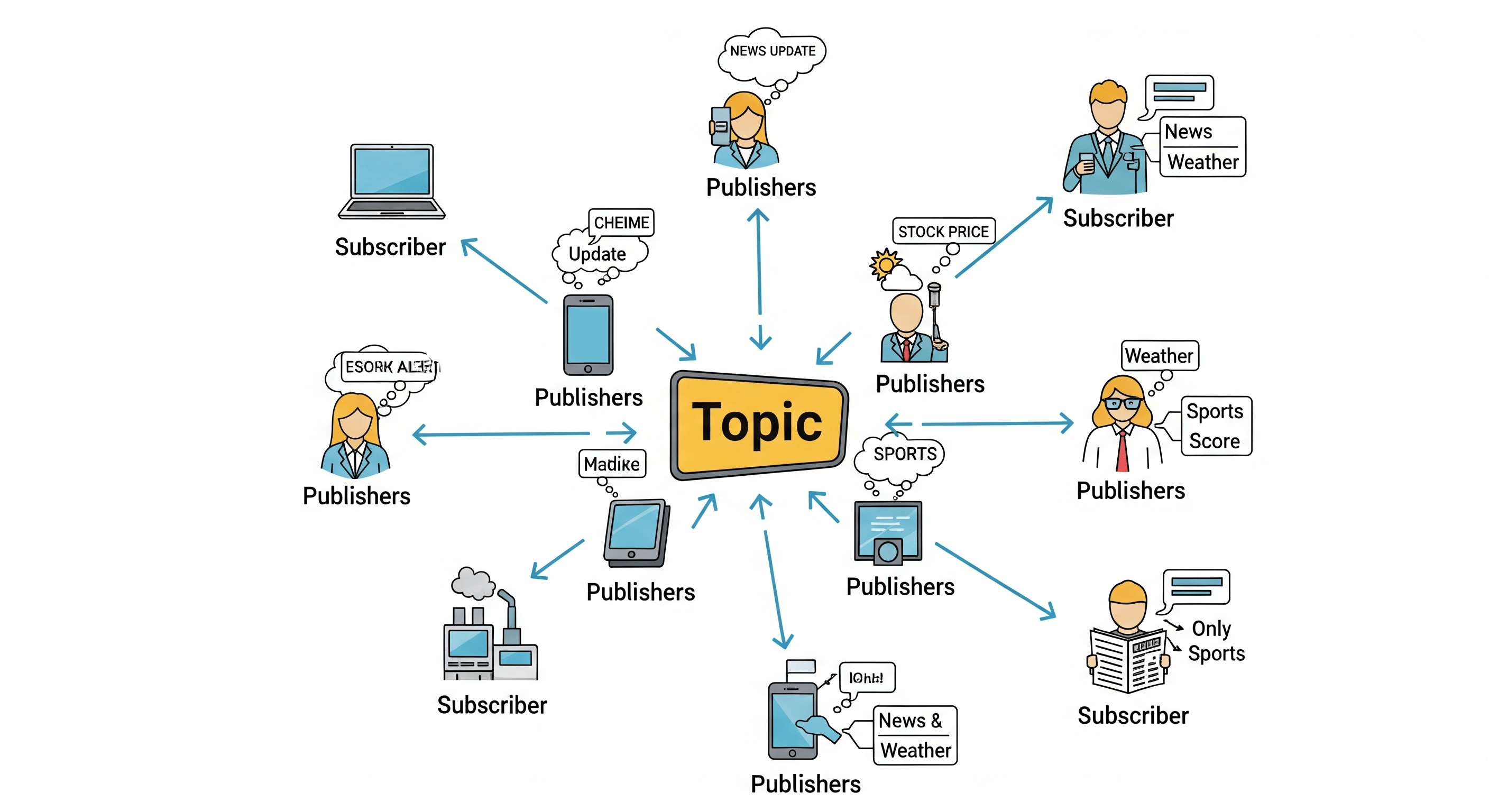
At its core, MQTT facilitates communication between devices (often called "clients") through a central server, known as a broker.
Key Components
- Publisher: A client that sends messages to the broker on a specific "topic." For example, a temperature sensor might publish the current temperature to the topic
home/livingroom/temperature. - Subscriber: A client that tells the broker it is interested in receiving messages on one or more topics. A mobile app, for instance, could subscribe to
home/livingroom/temperatureto display the current reading. - Broker: The central server that receives all messages from publishers and forwards them to the appropriate subscribers. The broker's job is to filter messages based on topic subscriptions, ensuring clients only receive the data they care about.
- Topic: A simple, hierarchical string (e.g.,
factory/machine-1/vibration) that acts as a label for messages. It allows the broker to route messages from publishers to subscribers efficiently.
The Publish-Subscribe (Pub/Sub) Model
Unlike traditional client-server models where clients communicate directly with a server, the pub/sub model decouples publishers and subscribers.
- Decoupling in Space: The publisher and subscriber do not need to know each other's IP address or location. They only need to know the address of the broker.
- Decoupling in Time: The publisher and subscriber do not need to be running at the same time. The broker can store messages for subscribers that are temporarily offline (depending on configuration).
- Decoupling in Synchronization: Operations on both components are not halted while publishing or receiving messages. This makes the system highly responsive and efficient.
This architecture makes MQTT incredibly scalable and robust, which is why it's a cornerstone of modern IoT and IIoT applications, from smart homes to massive industrial sensor networks.
The Architect's Guide to Mastering MQTT: From Core Principles to Enterprise-Scale Deployment
The introduction above presents the fundamental concepts of the MQTT protocol. Now, we will add over 3000 words to create a definitive, expert-level pillar page for anyone serious about building robust and scalable Internet of Things solutions. This deep dive will explore the architectural implications of MQTT, the critical role of the broker, the strategic use of advanced features, and the best practices required to move from a simple prototype to a secure, enterprise-grade IIoT architecture. This is the masterclass for understanding MQTT not just as a protocol, but as the central nervous system of a modern IoT platform.
Part 1: The Publish-Subscribe Model - A Paradigm Shift for IoT
The power of the MQTT publish-subscribe model cannot be overstated. The decoupling it provides is the key to building systems that are scalable, resilient, and flexible. Let's explore the profound implications of this architectural pattern compared to the traditional request-response model of HTTP.
In an HTTP-based system, a client that wants to know the temperature must constantly poll the server by sending requests. This is inefficient and leads to several problems in an IoT context:
- High Overhead: Each HTTP request and response has verbose headers, consuming significant bandwidth. This is a major issue for battery-powered devices on cellular networks.
- Poor Responsiveness: The client only gets new data when it asks for it. This introduces latency and makes real-time applications difficult.
- Tight Coupling: The client must know the direct IP address or endpoint of the a makes the system brittle.
MQTT's pub-sub model flips this on its head. Clients maintain a persistent, stateful connection to the MQTT broker. When new data is available, the broker pushes it instantly to all subscribed clients. This results in:
- Extreme Efficiency: The MQTT header is tiny (as small as 2 bytes), and the persistent connection eliminates the overhead of repeated requests.
- Real-Time Data Flow: Data is delivered with very low latency, making it perfect for command-and-control applications and live IoT data visualization on a platform like the MQTTfy dashboard.
- Architectural Flexibility: The broker acts as a central data bus. You can add new publishers (e.g., a new sensor) or new subscribers (e.g., a data logging service) to the system without having to reconfigure any of the existing components. This is the key to building a scalable and evolvable IoT platform.
Part 2: The MQTT Broker - The Heart of Your IoT Platform
While clients are the endpoints, the MQTT broker is the central intelligence of the entire system. It is far more than a simple message forwarder. A professional broker is a high-performance server application responsible for:
- Session Management: Managing the state for thousands or even millions of concurrently connected clients. This includes their subscription lists and the queue of undelivered messages for offline clients with persistent sessions.
- Authentication & Authorization: Securely authenticating every connecting client and enforcing granular access control rules to determine which topics they can publish or subscribe to.
- Message Routing: Efficiently filtering the massive firehose of incoming messages and routing them only to the relevant subscribers with microsecond latency.
- High Availability: In a production IIoT architecture, a single broker is a single point of failure. Enterprise-grade brokers are designed to be clustered together, so if one server fails, others instantly take over, ensuring continuous operation.
Choosing the right broker is a critical decision. While a simple broker is fine for a small project, a large-scale deployment requires a broker architected for clustering, high performance, and robust security. For more on this, see our guide on MQTT best practices.
Part 3: Mastering MQTT Features for Robust IoT Applications
The simplicity of the MQTT protocol is deceptive. It contains a set of powerful features that, when used correctly, allow you to build incredibly reliable and resilient systems.
Quality of Service (QoS): Your Delivery Guarantee
MQTT acknowledges that IoT networks can be unreliable. MQTT Quality of Service (QoS) allows you to choose the level of delivery guarantee for each individual message:
- QoS 0 (At most once): The message is sent once and forgotten. It's the fastest but offers no guarantee. Ideal for high-frequency, non-critical sensor data where losing a single reading is acceptable.
- QoS 1 (At least once): The sender stores the message until it receives an acknowledgment from the receiver. This guarantees delivery but might result in duplicates if the acknowledgment is lost. This is the most common QoS level, perfect for important status updates or commands.
- QoS 2 (Exactly once): The most reliable, but also the slowest level. It uses a four-part handshake to ensure the message is delivered exactly once. This should be reserved for critical operations like billing transactions or remote firmware updates.
Retained Messages: The Last Known Good Value
When a client publishes a message with the retain flag set to true, the MQTT broker stores that message for that specific topic. The moment a new client subscribes to that topic, the broker immediately sends it this "retained" message. This is incredibly powerful for stateful information. For example, a smart thermostat can publish its current setpoint as a retained message. When you open your MQTT dashboard, it can subscribe and instantly display the current setpoint without having to wait for the thermostat to publish a new value.
Last Will and Testament (LWT): Detecting Unplanned Disconnects
What happens if a device in the field loses power or crashes? The LWT feature is MQTT's elegant solution. When a client connects, it can register a "last will" message with the broker. If the client disconnects ungracefully (without sending a proper DISCONNECT packet), the broker will automatically publish this last will message on its behalf. The standard practice is to publish a message like {"status": "offline"} to a topic such as devices/device-123/status. This allows a monitoring system or IoT data visualization tool to immediately know that the device has failed, a critical feature for any robust IIoT architecture.
Part 4: The Evolution to MQTTv5 - Powering Modern IoT
While MQTT v3.1.1 was a massive success, the growth of hyper-scale IoT deployments revealed opportunities for improvement. The MQTTv5 features introduce a host of powerful capabilities designed for modern applications.
Key improvements include:
- Shared Subscriptions: A game-changing feature for backend scalability. It allows you to load-balance a high-throughput stream of messages across a group of subscribing clients (e.g., multiple instances of a data-processing service). This is essential for building a scalable and resilient IoT platform.
- Enhanced Error Reporting: In v5, the broker provides specific reason codes for failed operations. This makes debugging distributed systems vastly easier.
- Session and Message Expiry: You can now set expiry intervals for sessions and individual messages, which helps prevent resource leaks on the broker and ensures that time-sensitive data doesn't get delivered late.
- User Properties: You can add custom key-value metadata to MQTT packets, allowing for richer application-level context without cluttering the payload.
These features make MQTTv5 the clear choice for any new, large-scale IoT or IIoT project.
Part 5: A Blueprint for Secure MQTT Deployments
Security cannot be an afterthought. A compromised IoT system can have devastating consequences. A multi-layered approach to secure MQTT is essential.
- Encryption: Always use MQTT over TLS/SSL (MQTTS). This encrypts all data in transit, protecting it from eavesdropping.
- Authentication: Never allow anonymous clients. Every device must authenticate itself to the broker using strong credentials, such as unique client certificates or token-based authentication.
- Authorization: Once authenticated, a client should only have permission to do its specific job. Use Access Control Lists (ACLs) on the broker to enforce the Principle of Least Privilege. A sensor should only be able to publish to its own topic and should not be able to subscribe to anything.
By following these MQTT best practices, you can build an IoT platform that is resilient to cyber threats.
Part 6: Real-World Applications and IoT Data Visualization
The power of the MQTT protocol is that it enables a vast range of applications:
- Industrial IoT (IIoT): Connecting legacy factory equipment using a Modbus to MQTT gateway to enable predictive maintenance and real-time production monitoring.
- Smart Cities: Managing traffic lights, smart parking sensors, and public utilities.
- Connected Vehicles: Streaming telemetry data from cars for analysis and sending remote commands.
In all these applications, the ability to see the data is crucial. This is where an IoT data visualization platform like MQTTfy becomes essential. An effective MQTT dashboard subscribes to the relevant MQTT topics and transforms the raw data streams into intuitive gauges, charts, and maps, giving operators a real-time view into the health and status of their entire distributed system.