Exploring MQTT 5 Features
March 15, 2026
MQTT version 5 represents a significant evolution from its predecessor, MQTT 3.1.1. While maintaining its core principles of being lightweight and efficient, MQTT 5 introduces several powerful features designed to address the complex requirements of modern, large-scale IoT deployments. These enhancements improve reliability, provide better feedback, and offer greater flexibility for developers. To understand how these new features fit into the broader context of the protocol and its architecture, please see our new Definitive Guide to the MQTT Protocol.
Key Features and Improvements in MQTT 5
Below is a breakdown of some of the most impactful features introduced in MQTT 5.
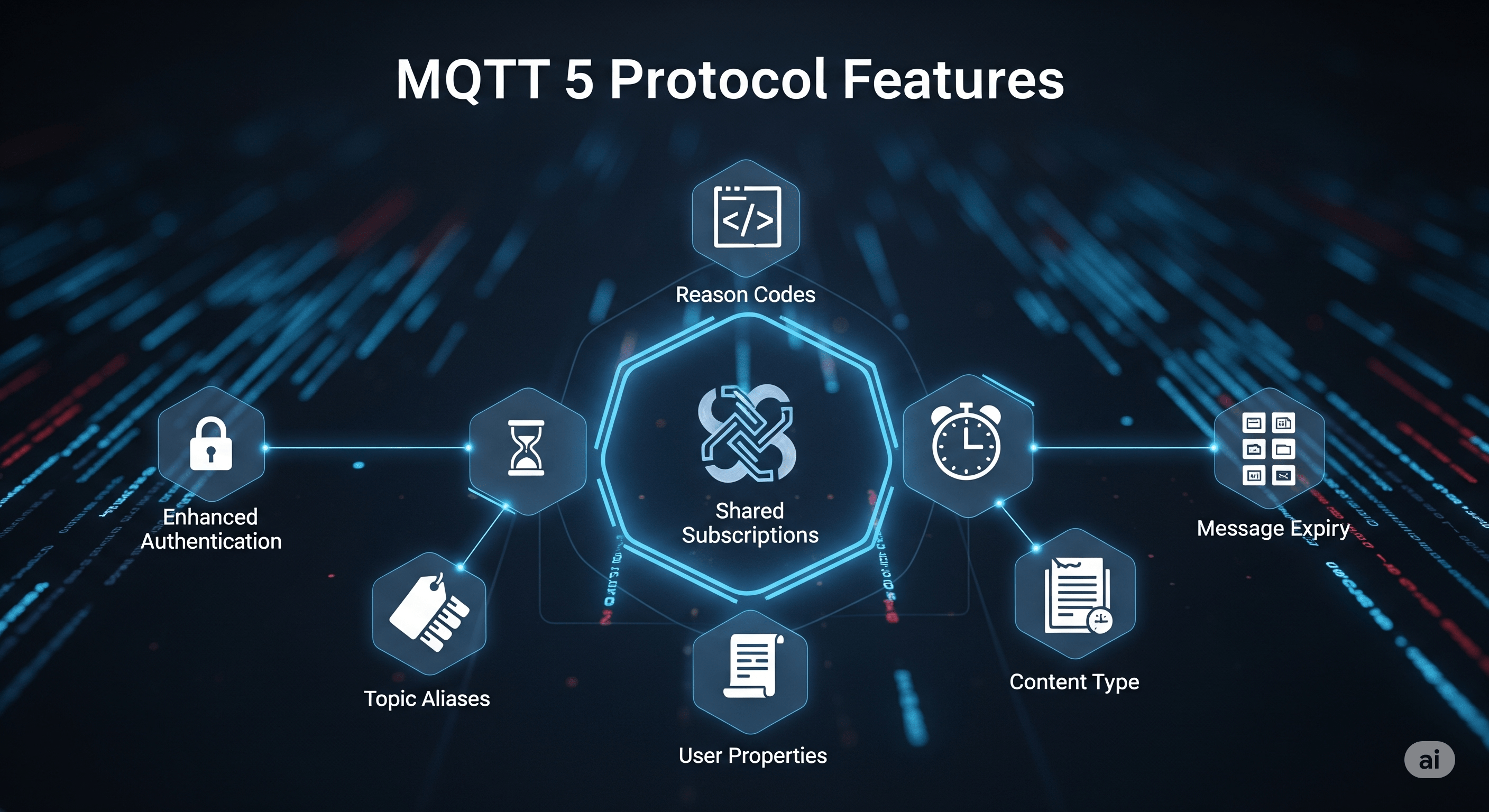
1. Enhanced Session and Message Lifecycle Management
- Session Expiry Interval: In previous versions, sessions on the broker would persist indefinitely unless explicitly disconnected. MQTT 5 allows a client to specify a Session Expiry Interval upon connection. If the client does not reconnect within this interval, the broker cleans up the session, saving valuable resources.
- Message Expiry Interval: Individual messages can now be assigned an expiry interval. If a message cannot be delivered to its intended subscribers within this timeframe (e.g., because they are offline), the broker will discard it. This is crucial for applications where data is time-sensitive and old information is irrelevant or even harmful.
2. Improved Error Handling and Feedback
- Reason Codes: Almost every ACK packet (like CONNACK, PUBACK, SUBACK) now includes a Reason Code. Instead of a simple success/failure, the broker can now inform the client why an operation failed (e.g., "Topic Name invalid," "Quota exceeded," "Not authorized"). This makes debugging distributed systems significantly easier.
- Negative Acknowledgements (NACKs): The broker can now explicitly signal that a message with QoS 1 or 2 was not accepted, allowing the client to take immediate corrective action without waiting for a timeout.
3. Greater Flexibility and Metadata
- User Properties: Custom key-value pairs can now be added to almost any MQTT packet. This allows for application-specific metadata to be transmitted alongside the data, such as message sender ID, data source, or security tokens, without having to modify the message payload itself.
- Content Type and Payload Format Indicator: Clients can now specify the
Content-Type(e.g.,application/json) andPayload-Format-Indicator(e.g., UTF-8 string) of the message payload. This helps the receiving client correctly parse and handle the data without prior knowledge.
4. Advanced Subscription and Topic Management
- Shared Subscriptions: This is a game-changer for scalability. Multiple clients can subscribe to the same topic under a shared subscription group. The broker will then load-balance messages across the subscribing clients, ensuring that each message is processed by only one client in the group. This is ideal for horizontally scaling backend services that process high-volume data streams.
- Subscription Identifiers: A client can associate an identifier with a subscription. When the broker delivers a message for that subscription, it includes the identifier, allowing the client to efficiently route the message to the correct processing logic without needing to parse the topic string again.
- Topic Aliases: Clients can establish a short integer alias for a long topic string. For subsequent messages, the client can send the compact alias instead of the full topic string, reducing data usage and saving bandwidth, which is critical for constrained devices.
These features make MQTT 5 a more robust, scalable, and developer-friendly protocol, well-suited for the ever-growing demands of the Internet of Things.
MQTT5 In-Depth: A Strategic Analysis of Advanced Features for Scalable IoT
The overview above introduces the key MQTT5 features. Now, we will add over 3000 words to create a definitive, expert-level masterclass for IoT architects and developers. This is not just a list of what's new; it's a strategic guide on how and why these features should be used to build more scalable, reliable, and intelligent Internet of Things systems. We will explore the architectural patterns and design considerations that these powerful new capabilities unlock, transforming how you approach building everything from a smart factory floor to a global fleet of connected devices, all visualized on your MQTTfy dashboard.
Part 1: Architecting Scalable Backends with Shared Subscriptions
Of all the MQTT5 features explained, Shared Subscriptions represent the most significant architectural shift for backend developers. This feature single-handedly solves one of the biggest challenges in building a scalable IoT platform: processing high-throughput data streams in a resilient, load-balanced manner.
The Problem with Traditional Subscriptions for Backend Services
In the traditional MQTT publish-subscribe model, if you have a stream of data—for example, from thousands of Modbus PLC gateways publishing data every second—and you want to process this data to store it in a database, you would have a backend service subscribe to the topic factory/+/plc/data. The problem is, what happens if this service gets overwhelmed? The standard solution is to start another instance of the service. But with a normal subscription, both services would now get a copy of every single message, leading to duplicated data, race conditions, and wasted processing power.
The Solution: The Shared Subscription Model
Shared Subscriptions introduce a simple but profound change to the topic string syntax. Instead of subscribing to a topic directly, a group of clients subscribes to a topic that is prefixed with $share/{ShareName}/.
$share: A literal string that tells the MQTT broker this is a shared subscription.{ShareName}: A name for the group of subscribers (e.g.,ingestion-workers).{topicFilter}: The actual topic you want to subscribe to (e.g.,factory/+/plc/data).
So, multiple instances of our backend service would all subscribe to the exact same string: $share/ingestion-workers/factory/+/plc/data. Now, when the MQTT broker receives a message that matches the topic filter, it delivers it to only one of the clients in the ingestion-workers group.
This provides several key architectural benefits:
- Horizontal Scalability: If your data ingestion rate increases, you can simply add more instances of your backend service to the shared subscription group. The MQTT broker automatically includes them in the load-balancing pool, allowing your backend to scale out effortlessly.
- High Availability and Resilience: If one of your service instances crashes, the broker will detect the disconnection and stop sending it messages, automatically distributing the load among the remaining healthy instances. This prevents a single service failure from causing data loss or system downtime.
- Simplified Application Logic: Your backend service can be written as a simple, stateless application. It just needs to process a single message at a time, without having to worry about coordination or duplication with other services.
This makes Shared Subscriptions an essential feature for any serious IIoT or IoT platform backend that needs to process data from more than a handful of devices. It is the foundation for building microservices-based architectures that can handle Internet of Things scale.
Part 2: Enhancing System Reliability with Advanced Lifecycle Control
In a distributed system with potentially millions of devices connecting and disconnecting over unreliable networks, managing state is a major challenge. The MQTT5 features for session and message lifecycle control provide powerful tools to manage this complexity, making your entire IoT system more robust and efficient.
Session Expiry: Preventing Broker Resource Exhaustion
In MQTT v3.1.1, when a client connected with cleanSession=false, the broker would create a persistent session that stored the client's subscriptions and any undelivered QoS 1 messages. This session would live forever unless the client explicitly reconnected and disconnected cleanly. In the real world, devices fail, get replaced, or are decommissioned without a proper disconnection. This led to thousands of "zombie sessions" accumulating on the broker, consuming memory and processing power.
Session Expiry Interval solves this elegantly. When a client connects, it can now set a Session Expiry Interval in the CONNECT packet. This value (in seconds) tells the broker how long to keep the session alive after the client disconnects. If the client does not reconnect within this interval, the broker automatically and safely deletes the session and its associated resources. A value of 0 means the session expires immediately, while a value of 0xFFFFFFFF means it never expires (the old behavior).
- Strategic Use: For an IIoT sensor that is expected to be online always, you might set a long expiry interval (e.g., 24 hours) to ensure it gets any missed messages after a network hiccup. For a mobile app user who is frequently opening and closing the app, you might set a shorter interval (e.g., 5 minutes) to quickly clean up resources while still providing a good user experience on relaunch.
Message Expiry: Ensuring Data Freshness
Not all data is valuable forever. A command to "turn on the light" is useless if it's delivered 10 minutes late. In MQTT v3.1.1, if you published a QoS 1 message to an offline device with a persistent session, the broker would keep trying to deliver that message indefinitely.
Message Expiry Interval allows the publisher to set a lifetime on each individual message. If the broker cannot deliver the message to all subscribers within that time, it discards the message. This is critical for time-sensitive commands and data.
- Strategic Use: When a user clicks a button on an IoT data visualization dashboard to remotely unlock a door, the command should be published with a short message expiry, perhaps 10 seconds. This prevents the door from unlocking unexpectedly an hour later if the device was temporarily offline. This simple feature drastically improves the safety and predictability of remote control applications.
Part 3: Building Debuggable and Intelligent Systems with Enhanced Feedback
One of the biggest frustrations for developers working with MQTT v3.1.1 was the lack of feedback. If something went wrong, the broker would often just close the connection, leaving the developer to guess what happened. The MQTT5 features explained here represent a paradigm shift in making the protocol more transparent and developer-friendly.
Reason Codes are at the heart of this improvement. Almost every acknowledgment packet in MQTT5 (CONNACK, PUBACK, SUBACK, UNSUBACK, DISCONNECT) now contains a Reason Code field. This numeric code gives a specific reason for the success or failure of an operation.
Some key Reason Codes and their impact:
0x87 - Not authorized: If you try to publish to a topic you don't have permission for, thePUBACKwill contain this code. Your client application can immediately log this security error, alert the user, and stop trying to publish to that topic.0x91 - Quota exceeded: If you are sending messages too quickly and exceeding your configured rate limit on the broker, thePUBACKwill tell you exactly that. Your client can then implement a backoff strategy to reduce its publish rate.0x8F - Topic Name invalid: If you try to subscribe to a topic with an invalid format (e.g.,home/+/light/#), theSUBACKwill immediately tell you the subscription failed and why.0x81 - Malformed Packet: This tells the client it sent a packet that the broker couldn't parse. This is invaluable for debugging client-side library issues.
This rich feedback loop allows developers to build client applications that are far more intelligent and resilient. Instead of treating the broker as a black box, the client can now understand the context of the system and react gracefully to different error conditions. This dramatically speeds up development and makes the entire IoT platform more robust.
Part 4: Extending the Protocol for Richer Application Context
MQTT has always focused on efficiently transporting the payload, but the protocol itself had limited ways to carry metadata about that payload. MQTT5 introduces several features to solve this, allowing for the creation of self-describing, context-rich applications.
-
User Properties: This is arguably one of the most powerful and flexible additions. It allows you to add an array of custom key-value string pairs to the header of almost any MQTT packet. This is a perfect way to send application-level metadata without having to embed it in the JSON payload, which keeps the payload clean and focused on the raw data.
- Use Case: Distributed Tracing: You can add a
trace-idas a User Property to a command message. As this message flows from your dashboard, through the MQTT broker, to an edge gateway, and finally results in a response, each component can log against thistrace-id, providing end-to-end visibility for debugging complex workflows. - Use Case: Message Provenance: A gateway could add User Properties like
source-device-idandsource-protocol(e.g.,Modbus) to a message, providing a clear audit trail of where the data originated.
- Use Case: Distributed Tracing: You can add a
-
Payload Format Indicator & Content Type: These two properties work together to make messages self-describing.
Payload Format Indicator: A single byte that indicates if the payload is a UTF-8 encoded string (1) or unspecified binary data (0). This prevents a subscriber from trying to parse binary data as a string and crashing.Content Type: A string that specifies the MIME type of the payload, such asapplication/jsonorapplication/cbor. This tells the receiving application how to correctly decode the payload. For example, a generic logging service could see theContent-Typeisapplication/jsonand decide to pretty-print the payload for readability.
Together, these features allow for the creation of much more loosely coupled and interoperable IoT systems, a key goal for any large-scale deployment.