What is the Internet of Things (IoT)?
March 15, 2026
What is the Internet of Things (IoT)?
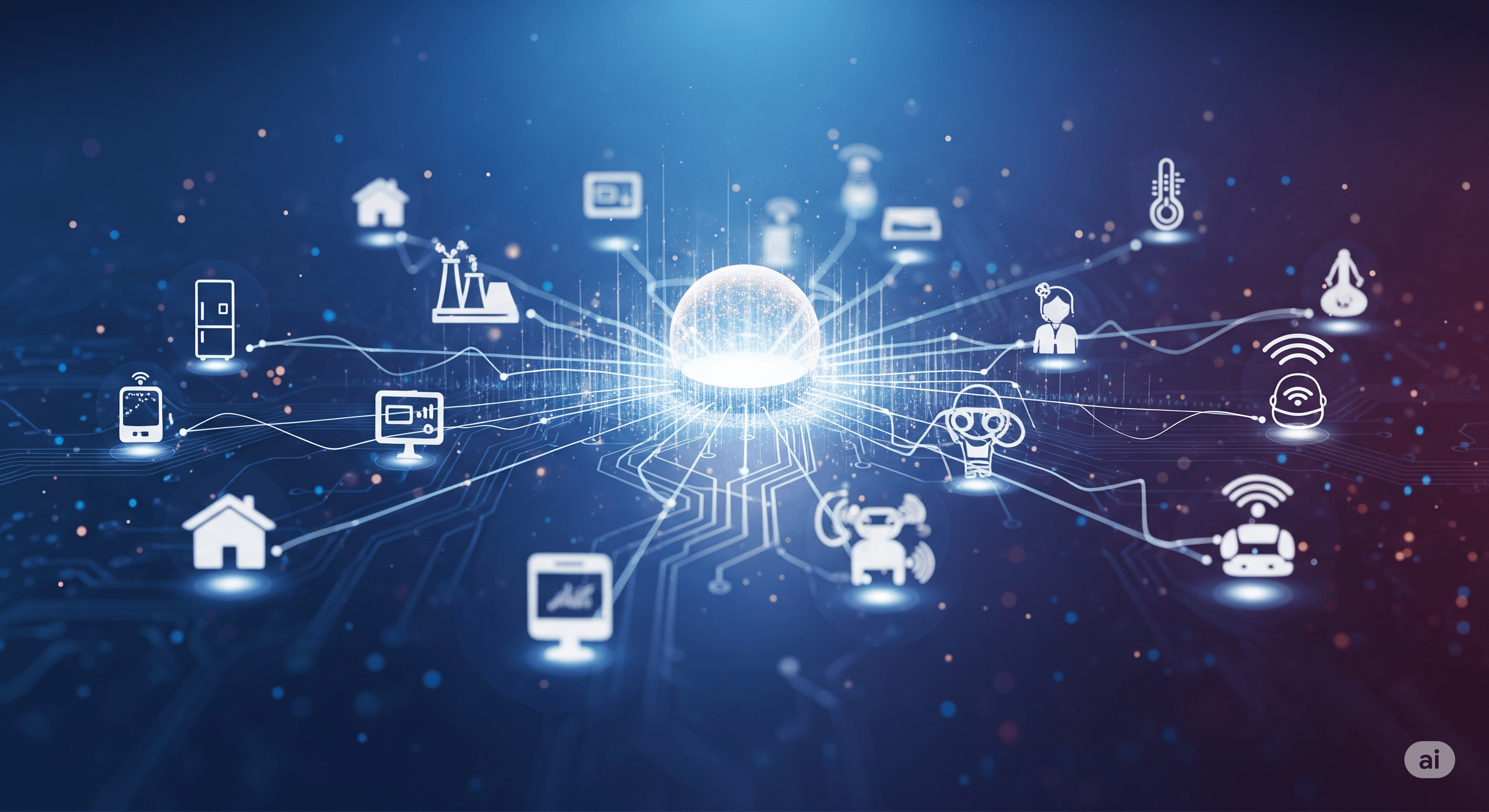
The Internet of Things (IoT) refers to the vast network of physical objects—or "things"—that are embedded with sensors, software, and other technologies for the purpose of connecting and exchanging data with other devices and systems over the internet.
These devices range from ordinary household objects, like smart light bulbs, to sophisticated industrial tools. In essence, IoT is about extending the power of the internet beyond computers and smartphones to a huge range of other things and environments.
How Does IoT Work? The Four Key Components
A typical IoT system works by collecting and exchanging data through four fundamental components:
- Sensors/Devices: The "things" that collect data from their environment (e.g., a temperature sensor, a GPS tracker).
- Connectivity: The mechanism for sending that data. This is often handled by an IoT Gateway which uses protocols like Wi-Fi or Cellular to send data, often via MQTT, the standard for IoT messaging.
- Data Processing: Software in the cloud or on an edge device processes the data, from simple checks to complex AI-driven analysis.
- User Interface: How the information is presented to the user, such as a web dashboard or a mobile app.
Real-World Examples of IoT
| Domain | Example | How it Works |
|---|---|---|
| Smart Home | Smart Thermostat | A thermostat learns your schedule and adjusts the temperature to save energy, controllable from your phone. |
| Wearables | Fitness Tracker | Sensors monitor your heart rate and steps, sending data to an app for health insights. |
| IIoT | Predictive Maintenance | Sensors on factory machinery stream data to predict failures before they happen, a key use case for industrial IoT. |
| Smart Cities | Smart Parking | Sensors detect open parking spaces and guide drivers via a mobile app, reducing traffic. |
The Internet of Things is creating intelligent systems that can sense, analyze, and act on data from the physical world, transforming our homes, cities, and industries.
The Internet of Things Masterclass: From Architecture to Business Revolution
The overview above provides a crucial introduction to the Internet of Things. Now, we will embark on a definitive deep dive, adding thousands of words to create an expert-level, pillar-page guide to the entire IoT ecosystem. We will dissect the intricate technology stack, explore the profound business transformation it enables, analyze its societal impact, and forecast the future of our increasingly connected world. This is the masterclass for understanding IoT not just as a technology, but as a fundamental force reshaping our economy and society.
Part 1: Deconstructing the IoT Technology Stack
To truly grasp the Internet of Things, one must understand its constituent layers. A functional, scalable, and secure IoT architecture is a complex interplay of hardware, networking, and software, each with its own set of challenges and considerations.
The Foundation: Device Hardware (The "Things")
This physical layer is where the digital world meets the real world. The quality and choice of hardware directly impact the reliability and richness of the data collected.
-
Microcontrollers (MCUs): These are the brains of an IoT device. They are tiny, low-power computers on a single chip. The market is diverse, with options for every use case. The ESP32 has become a favorite in the maker community and for rapid prototyping due to its integrated Wi-Fi and Bluetooth, low cost, and powerful dual-core processor. For industrial applications requiring higher reliability and more peripherals, MCUs from manufacturers like STMicroelectronics (the STM32 series) or NXP are common. The choice of MCU dictates the device's processing power, power consumption, and connectivity options.
-
Sensors: These are the digital senses of the device. The variety is immense:
- Environmental Sensors: Temperature, humidity (DHT22, BME280), barometric pressure, and air quality sensors (MQ series for gases, SGP30 for VOCs and eCO2) are fundamental for everything from smart homes to industrial compliance.
- Motion & Position Sensors: Accelerometers and gyroscopes (like the MPU-6050) are used in everything from wearable fitness trackers to detecting vibration in machinery for predictive maintenance. GPS/GNSS receivers provide precise location data for logistics and asset tracking.
- Optical Sensors: Simple photoresistors can detect ambient light. Advanced image sensors, combined with edge AI processors, can perform object detection, read QR codes, or monitor production lines for quality control.
-
Actuators: If sensors are the senses, actuators are the muscles. They convert digital commands back into physical actions. This includes relays to switch high-voltage circuits (like lights or motors), servo and stepper motors for precise movement in robotics, and solenoid valves to control the flow of liquid or gas.
The Backbone: Connectivity and Networking
Connecting billions of IoT devices requires a diverse set of communication technologies. There is no one-size-fits-all solution; the choice is a critical trade-off between range, bandwidth, power consumption, and cost.
-
Local Area Networks (LAN):
- Wi-Fi: Ubiquitous, high-bandwidth, and well-understood. Its primary drawback is power consumption, making it unsuitable for many battery-powered devices. It is ideal for devices with access to mains power, like smart home hubs or indoor industrial sensors.
- Bluetooth & BLE: Bluetooth Low Energy (BLE) is optimized for very low power consumption, making it perfect for wearables and battery-powered sensors that need to communicate with a nearby hub or smartphone. Its range is limited, typically to a single room.
-
Low-Power Wide-Area Networks (LPWAN): This category is a game-changer for the Internet of Things, enabling long-range communication with multi-year battery life.
- LoRaWAN: An open standard that allows anyone to set up their own network. It offers a range of several kilometers in rural areas and has excellent penetration through buildings. The trade-off is very low bandwidth—only a few bytes per message.
- NB-IoT (Narrowband IoT) & LTE-M: These are cellular technologies that operate on licensed spectrum, providing carrier-grade reliability. They offer better bandwidth than LoRaWAN and have the advantage of using existing cellular infrastructure.
-
The Unifying Language: The MQTT Protocol: Regardless of the underlying physical network, the data needs a common language. The MQTT protocol has emerged as the de facto standard for IoT messaging. Its lightweight header, publish-subscribe model, and reliability features (like QoS and Last Will and Testament) are perfectly designed for the high-latency, low-bandwidth, and unreliable nature of many IoT networks. It is the crucial protocol that decouples the hardware from the software.
The Brain: The IoT Platform
An IoT platform is the powerful and complex software backend that ties everything together. Building a custom platform is a massive undertaking, which is why most companies leverage existing platforms like MQTTfy, AWS IoT, or Azure IoT. A complete platform must provide several key services:
- Device Management & Connectivity: At the heart of the platform is a high-availability MQTT broker (like the Synapse MQTT broker) that can handle millions of concurrent device connections. The platform is responsible for authenticating and authorizing devices, managing their digital twins, and handling over-the-air (OTA) firmware updates.
- Data Integration and Processing: The platform must be able to ingest the firehose of data and route it accordingly. A rules engine allows for real-time data processing, such as triggering an alert if a temperature exceeds a certain threshold.
- Data Storage: IoT data is typically time-series data. The platform needs to store this efficiently in specialized time-series databases (like InfluxDB or TimescaleDB) for historical analysis and visualization.
- Application Enablement: The platform exposes the data and device controls through APIs, allowing developers to build user-facing applications. This includes providing the tools to create a rich, real-time MQTT dashboard for IoT data visualization.
Part 2: The Industrial Internet of Things (IIoT) - A Revolution in Efficiency
While consumer IoT often grabs headlines, the Industrial Internet of Things (IIoT) is where the most significant economic value is being created. IIoT is about instrumenting the physical world of industry—factories, power plants, agriculture, and logistics—to drive unprecedented levels of efficiency, safety, and productivity.
-
From Reactive to Predictive Operations: The core paradigm shift of IIoT is moving from a reactive model ("fix it when it breaks") to a predictive one ("fix it before it breaks"). For a factory, unplanned downtime can cost tens of thousands of dollars per hour. Predictive maintenance, enabled by IIoT sensors, is the single most valuable use case. By analyzing vibration, temperature, and acoustic data, machine learning models can predict the remaining useful life of a component, allowing maintenance to be scheduled during planned downtime.
-
The Digital Twin: A Virtual Replica: A digital twin is a high-fidelity virtual model of a physical asset, process, or system. It is kept in perfect sync with its real-world counterpart using a continuous stream of data from IIoT sensors. A manufacturer can have a digital twin of their entire production line. They can use this virtual model to simulate the impact of a change (e.g., increasing the speed of a conveyor belt) to identify bottlenecks or a potential failure before making a costly physical change. This is a powerful tool for optimization and process improvement.
-
Interoperability with MQTT and Sparkplug B: The industrial world is filled with legacy equipment from hundreds of different vendors, speaking dozens of different protocols. The MQTT protocol acts as a universal translator. An edge gateway can connect to a PLC (Programmable Logic Controller) using its native protocol (e.g., Modbus, OPC-UA) and then translate and publish that data in a standardized format over MQTT. To solve this data format problem, the MQTT Sparkplug B specification was created. It defines a standard topic namespace and payload structure for IIoT data, ensuring that devices and applications from different vendors can communicate seamlessly. This is a critical enabler for true, multi-vendor interoperability.
Part 3: IoT and the Transformation of Society
The impact of the Internet of Things extends far beyond business. It is fundamentally reshaping our cities, our environment, and our daily lives.
-
Smart Cities: Municipalities are leveraging IoT to become more efficient, sustainable, and livable.
- Intelligent Transportation: Smart traffic signals can adjust their timing based on real-time traffic flow, reducing congestion. Smart parking solutions use sensors to guide drivers to open spots, reducing the time (and emissions) spent circling the block.
- Waste Management: Smart bins equipped with ultrasonic sensors can signal when they are full. This allows waste management companies to optimize their collection routes, saving fuel and labor costs, and preventing overflowing bins.
- Public Safety: Networks of acoustic sensors can detect the sound of gunshots, automatically triangulating the location and alerting law enforcement within seconds.
-
Smart Agriculture (AgriTech): The Internet of Things is helping to solve one of the world's biggest challenges: feeding a growing population with limited resources.
- Precision Farming: By deploying a grid of soil moisture, pH, and nutrient sensors, farmers can move from watering and fertilizing an entire field to treating each square meter based on its specific needs. This drastically reduces water consumption, fertilizer runoff, and costs, while increasing crop yields.
- Livestock Monitoring: IoT-enabled ear tags on cattle can monitor their temperature, activity levels, and location. This can detect early signs of illness, allowing for prompt treatment and preventing the spread of disease through a herd. It can also help optimize grazing patterns.
-
Environmental Monitoring: Governments and environmental groups are using IoT to monitor the health of our planet. Networks of sensors are deployed to monitor air and water quality in real-time. Smart buoys in the ocean track currents, temperature, and salinity to better understand climate change. Drones equipped with multispectral cameras monitor forests for signs of drought or disease that could lead to wildfires.
Part 4: The Grand Challenges and the Future of IoT
For all its transformative potential, the path to a fully connected world is fraught with challenges. Successfully navigating these hurdles will define the future of the Internet of Things.
-
The Security Imperative: IoT security is not a feature; it is the foundation upon which trust is built. The consequences of a large-scale IoT breach could be catastrophic—imagine a hacked power grid or a compromised network of medical devices. A defense-in-depth strategy is essential, starting with secure hardware, enforcing encrypted communication with a secure MQTT broker, and implementing a robust plan for OTA firmware updates to patch vulnerabilities. Any IoT platform that does not have security as its primary design principle is a liability.
-
The Data Privacy and Ethics Dilemma: Every IoT device is a potential source of sensitive data. A smart thermostat knows when you are home and when you are away. A fitness tracker knows your health status. This raises critical questions about data ownership, consent, and usage. Businesses and governments must be transparent and ethical in how they collect and use this data, or they risk a massive public backlash.
-
The Symbiotic Future: IoT, AI, and 5G: The future of IoT is inextricably linked with advancements in Artificial Intelligence and 5G.
- AI as the Brain: AI and machine learning are the engines that will unlock the true value of IoT data. As we move forward, more of this AI will happen at the "edge." A smart camera won't just stream video; its onboard AI will analyze the video in real-time and only send a high-level alert (
"Package delivered"or"Intruder detected"). - 5G as the Nerves: 5G will provide the ultra-fast, ultra-reliable, low-latency communication needed for the most demanding IoT applications. This includes real-time V2X (Vehicle-to-Everything) communication for autonomous cars and the control of remote robotics for applications like telesurgery.
- AI as the Brain: AI and machine learning are the engines that will unlock the true value of IoT data. As we move forward, more of this AI will happen at the "edge." A smart camera won't just stream video; its onboard AI will analyze the video in real-time and only send a high-level alert (
Ultimately, the Internet of Things is about creating a digital nervous system for the physical world. It gives us the ability to monitor, understand, and optimize our homes, cities, industries, and planet in ways we are only just beginning to imagine. It is one of the most fundamental and transformative technological waves of our time.