Top 10 Industrial IoT (IIoT) Use Cases Revolutionizing Manufacturing
March 15, 2026
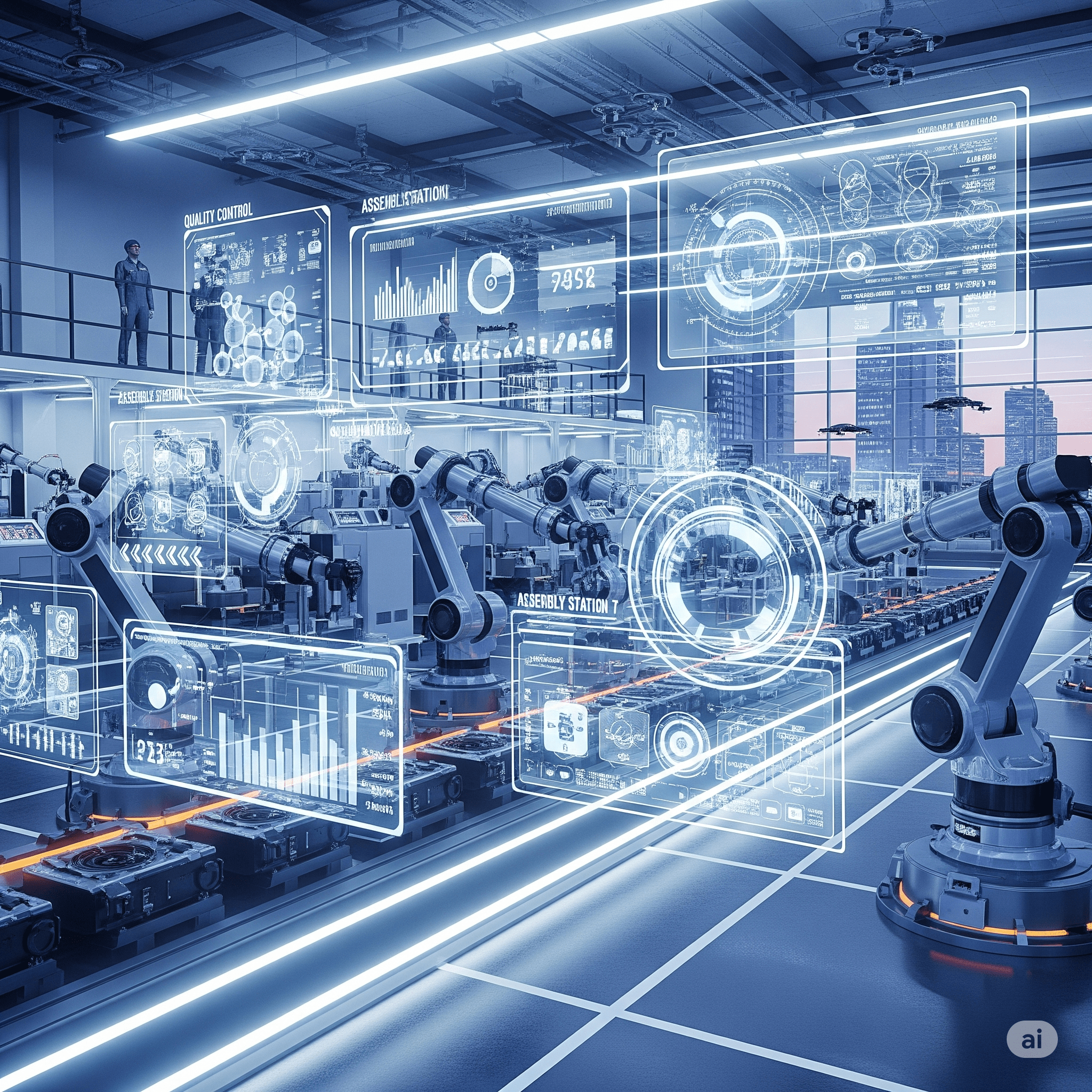
How IIoT is Transforming Modern Industry
The Industrial Internet of Things (IIoT) is the application of IoT technology to the manufacturing and industrial sectors. It involves connecting machinery, sensors, and enterprise systems to collect, analyze, and act upon vast amounts of data in real-time. This connectivity is fueling the "Fourth Industrial Revolution," or Industry 4.0, leading to unprecedented gains in efficiency, safety, and innovation.
The Core Value of IIoT
IIoT bridges the gap between the physical operational technology (OT) on the factory floor and the digital information technology (IT) of the enterprise. This integration provides a unified, real-time view of operations, enabling data-driven decision-making at every level.
The Top 10 IIoT Applications
| Rank | Use Case | Description | Key Benefits |
|---|---|---|---|
| 1 | Predictive Maintenance | Sensors monitor equipment (vibration, temperature, power draw) to predict failures before they happen, allowing for proactive maintenance. | Reduced downtime, lower repair costs, increased asset lifespan |
| 2 | Real-time Asset Tracking | GPS and RFID/BLE tags track the location and status of tools, equipment, and inventory within the factory and across the supply chain. | Improved asset utilization, reduced theft/loss, optimized workflows |
| 3 | Supply Chain Optimization | End-to-end visibility from raw material sourcing to final delivery, monitoring location, temperature, and handling of goods in transit. | Increased efficiency, reduced spoilage, improved delivery times |
| 4 | Energy Management | Smart meters and sensors monitor energy consumption of individual machines and entire facilities to identify waste and optimize usage. | Lower energy costs, reduced carbon footprint, improved sustainability |
| 5 | Digital Twins | A virtual model of a physical asset or process, updated with real-time sensor data. Used for simulation, analysis, and optimization. | Faster prototyping, risk-free testing, improved process design |
| 6 | Connected Worker Safety | Wearable sensors monitor workers' health, location, and exposure to hazardous environments (gases, noise), triggering alerts in emergencies. | Enhanced safety, faster emergency response, improved compliance |
| 7 | Quality Control & Vision | AI-powered cameras and sensors inspect products on the assembly line, detecting defects far more accurately and quickly than human eyes. | Reduced defects, improved product quality, lower scrap rates |
| 8 | Remote Operations & Control | Enables engineers to monitor and control machinery in remote or hazardous locations (e.g., oil rigs, mines) from a central control room. | Increased operational efficiency, improved worker safety |
| 9 | Smart Metering & Billing | Automated utility meters (water, gas, electricity) that provide real-time usage data for accurate billing and demand forecasting. | Eliminates manual readings, enables dynamic pricing, improves accuracy |
| 10 | Process Automation & SCADA | Integrating OT systems like PLCs and SCADA with IT systems via protocols like MQTT to enable more intelligent, data-driven automation rules. | Increased production speed, improved consistency, greater flexibility |
Deep Dive into the Top IIoT Use Cases
While the table above provides a high-level overview, the true power of IIoT is in the details. Let's explore the technical architecture, the role of data, and the tangible business impact of these transformative use cases.
1. Predictive Maintenance: From Reactive to Proactive
The Problem: For decades, maintenance has been either reactive (fixing something after it breaks, causing costly downtime) or based on a fixed schedule (replacing a part every 6 months, even if it's still perfectly healthy). Both are wildly inefficient.
The IIoT Solution: IIoT enables a proactive, condition-based approach. IoT devices equipped with vibration sensors, thermal imagers, and acoustic sensors are attached to critical machinery like motors, pumps, and presses. These sensors stream high-frequency data to an edge gateway.
Technical Architecture:
- Data Ingestion: Vibration data (waveforms) is streamed via MQTT to an edge device.
- Edge Analytics: The edge device runs a machine learning model to perform a Fast Fourier Transform (FFT) on the vibration data in real-time. Instead of sending the raw, high-volume waveform to the cloud, it only sends the much smaller, processed spectral analysis data.
- Cloud-Based AI: This processed data is published to a central Synapse MQTT broker in the cloud. The data is then fed into a more complex AI model that has been trained to recognize the specific vibration signatures that precede bearing wear, misalignment, or other common failures.
- Actionable Alerts: When the AI model detects an impending failure, it doesn't just flash a red light. It can automatically generate a work order in the company's CMMS, specifying the machine, the likely fault, and the required parts. This alert is also pushed to a real-time MQTTfy dashboard, giving maintenance managers a live overview of fleet health.
Business Impact: Companies implementing IIoT-driven predictive maintenance have reported up to a 70% reduction in unplanned downtime and a 30% reduction in maintenance costs.
2. Real-Time Asset Tracking and Smart Logistics
The Problem: In a large factory, a distribution center, or a global supply chain, valuable assets—tools, containers, vehicles, even high-value products—are constantly being lost, misplaced, or underutilized. This leads to wasted time, capital, and production delays.
The IIoT Solution: Low-power tracking devices using technologies like GPS (for outdoors), BLE (Bluetooth Low Energy), and LoRaWAN are attached to assets. These trackers publish their location and status at regular intervals.
Technical Architecture:
- Location Data: A forklift inside a warehouse might have a BLE tag. BLE gateways positioned around the facility receive the signal and triangulate the forklift's position.
- MQTT as the Data Bus: The gateway publishes the forklift's ID and its calculated coordinates (e.g.,
assets/forklift-04/location,{"x": 52, "y": 118}) to the central MQTT broker. - Geofencing and Visualization: A logistics application subscribes to these location topics. It can then plot the real-time position of every asset on a map within the MQTTfy dashboard. The application can also define "geofences"—virtual boundaries. If the forklift moves into an unauthorized area, or a high-value tool is detected leaving the facility, an immediate alert is triggered.
- Cold Chain Monitoring: For refrigerated goods in transit, the tracker can also include a temperature sensor. It publishes temperature data to a topic like
shipments/pharma-123/temperature. If the temperature goes outside the acceptable range, an alert is sent, potentially saving millions in spoiled inventory.
Business Impact: Improved asset utilization, reduced loss and theft, optimized workflows (e.g., automatically dispatching the nearest forklift), and auditable proof of compliance for regulated goods.
6. Connected Worker Safety: Your Most Valuable Asset
The Problem: Industrial environments can be dangerous. Workers may be exposed to toxic gases, operate in isolated areas, or suffer from heat stress. Ensuring a rapid response to any safety incident is a top priority.
The IIoT Solution: Workers are equipped with smart wearables—a connected hard hat, a vest, or a wristband. These are not consumer smartwatches; they are ruggedized IoT devices with specialized sensors.
Technical Architecture:
- Sensor Fusion: The wearable contains an accelerometer, a GPS/BLE module, a heart rate monitor, and sometimes a gas sensor (e.g., for H2S or CO).
- Event-Driven Alerts via MQTT: The device doesn't constantly stream data to save battery. It only publishes a message when an event occurs:
- Man Down: If the accelerometer detects a sudden fall followed by a period of no motion, it publishes a high-priority message to
workers/worker-78/alert,{"type": "fall_detected"}. - Panic Button: If the worker presses a physical button on the device, it sends a similar alert.
- Geofence Breach: If a worker without proper certification enters a hazardous zone, an alert is triggered.
- Man Down: If the accelerometer detects a sudden fall followed by a period of no motion, it publishes a high-priority message to
- Centralized Monitoring: A safety officer monitors a dedicated real-time safety dashboard. When an alert comes in, the worker's location is immediately pinpointed on a map, and the nature of the alert is displayed. The system can also automatically open a two-way audio channel through the wearable.
Business Impact: Dramatically faster emergency response times, improved compliance with safety regulations, and a safer overall work environment.
10. SCADA Modernization and IT/OT Convergence
The Problem: Traditional SCADA systems use legacy poll-response protocols (like Modbus or DNP3) that are inefficient and insecure. The data is often trapped in the isolated Operational Technology (OT) network, inaccessible to modern IT systems and analytics platforms.
The IIoT Solution: MQTT and platforms like MQTTfy act as the secure bridge between the OT and IT worlds.
Technical Architecture:
- Edge Gateway as a Bridge: An edge gateway is installed on the factory floor. It speaks the legacy protocols to the PLCs and other industrial controllers, collecting tag data.
- Standardization with Sparkplug B: Instead of publishing raw, unstructured data, the gateway uses the Sparkplug B specification. This standardizes the MQTT topic namespace and payload format, ensuring that data is published with context (e.g., engineering units, data types, tag metadata).
- A Decoupled Central Broker: The gateway makes a secure, outbound connection to a high-availability Synapse MQTT broker cluster. This avoids opening insecure inbound firewall ports into the OT network, a crucial step in securing IoT devices in an industrial setting.
- Unified Data Access: Once the data is in the broker, it's available to any authorized system. The legacy SCADA system can subscribe to the data it needs. Simultaneously, a modern, web-based MQTTfy dashboard can provide enterprise-wide visualization. And a cloud analytics platform can subscribe to the same data stream to perform historical analysis and train AI models.
Business Impact: This architecture breaks down data silos, enabling a single source of truth for both operational and business users. It dramatically improves security, scalability, and flexibility compared to traditional SCADA systems.
The Foundational Role of a Comprehensive IIoT Platform
Successfully implementing these use cases at scale is not just about connecting a few sensors. It requires a robust, secure, and scalable IIoT platform. This is where a comprehensive solution like MQTTfy becomes essential. A true platform provides an end-to-end solution:
- The Broker: A managed, high-availability broker like the Synapse MQTT broker that forms the reliable core of your data pipeline.
- The Dashboard: A flexible, user-friendly visualization tool like the MQTTfy dashboard that allows you to build custom dashboards for each use case and role.
- The Security: An integrated security model that simplifies device authentication, authorization, and data encryption.
- The Integration: Tools and APIs that make it easy to connect your IIoT data to other enterprise systems like ERPs, MES, and data lakes.
By leveraging a complete platform, companies can accelerate their Industry 4.0 journey, moving from pilot projects to full-scale deployments that deliver real, measurable business value.
The Role of MQTT in IIoT
MQTT has become a dominant protocol in IIoT for several key reasons:
- Lightweight: It can run on resource-constrained industrial controllers and sensors.
- Bandwidth-Efficient: It minimizes network usage, which is crucial in large factory environments with thousands of devices.
- Reliable: Its QoS levels ensure that critical command-and-control messages are delivered.
- Decoupled: The pub/sub model allows new sensors, machines, and applications to be added to the system without reconfiguring existing components.
As industries continue their digital transformation, IIoT will be the engine driving innovation. By connecting every aspect of the industrial process, companies can unlock new levels of productivity, create safer working environments, and build the smart factories of the future.