What is MQTT? A Deep Dive for AI Agent Developers
January 30, 2026
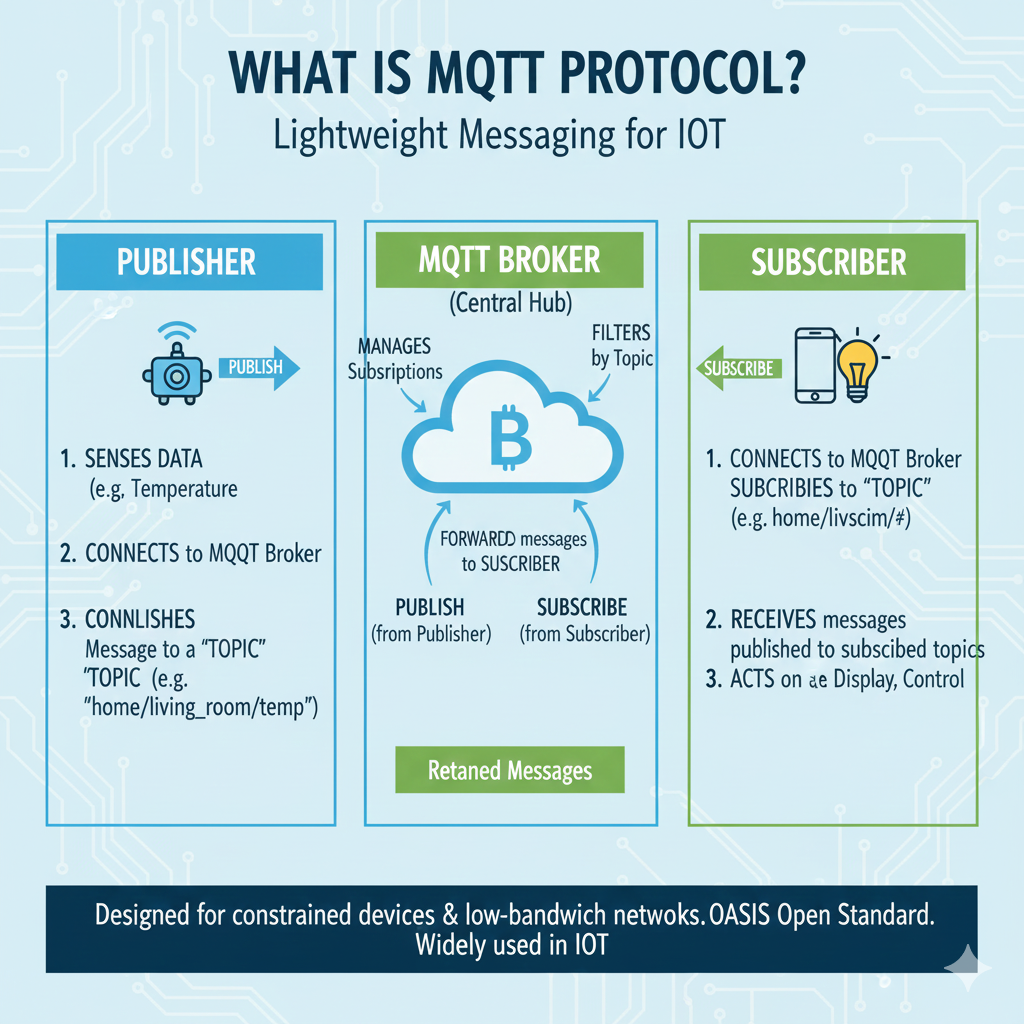
Introduction: The Lingua Franca of IoT
If you're building AI Agents that need to interact with the real world—from a smart home to an industrial factory floor—you'll inevitably encounter MQTT. Standing for Message Queuing Telemetry Transport, MQTT is a lightweight, publish-subscribe messaging protocol that has become the de facto standard for the Internet of Things (IoT). Its simplicity, efficiency, and reliability make it the perfect nervous system for connecting a vast array of devices to a central intelligence.
However, for an AI Agent developer, understanding MQTT is not just about knowing the definition. It's about understanding how to leverage its architecture to create agents that can effectively perceive and act upon the physical world. An AI agent doesn't just consume data; it uses protocols like MQTT as a tool to achieve its goals.
This guide will provide a deep dive into MQTT from the perspective of an AI Agent developer. We will explore not just the "what," but the "why" and "how"—focusing on topic design, payload structure, and the ways an intelligent agent can use MQTT as a powerful, bidirectional communication tool.
Core MQTT Concepts for AI Agents
At its heart, MQTT is built around a central Broker. This broker acts like a post office. Devices, often called clients, can either publish messages to specific "addresses" or subscribe to receive messages sent to those addresses.
-
Publish/Subscribe Model: Unlike traditional request/response models (like HTTP APIs), MQTT is asynchronous. A device publishes a piece of data (e.g., a temperature reading) to a topic and then moves on. It doesn't know or care if anyone is listening. Conversely, a subscriber expresses interest in a topic and will receive messages whenever they are published.
- Implication for AI Agents: This is perfect for event-driven agents. An agent can subscribe to a topic like
sensors/foundry/temperatureand be instantly triggered whenever a new reading is available, without constantly needing to poll an API endpoint.
- Implication for AI Agents: This is perfect for event-driven agents. An agent can subscribe to a topic like
-
The Broker: The central hub. It's responsible for receiving all messages and routing them to the appropriate subscribers. It also handles client connections, security, and session management.
-
Topics: These are the addresses for messages. Topics are structured as a hierarchy of strings separated by forward slashes (e.g.,
home/living_room/light/status). This hierarchical structure is incredibly powerful for organizing data and allowing for flexible subscriptions. -
Quality of Service (QoS): MQTT provides three levels of guaranteed delivery, ensuring reliability even over flaky networks:
- QoS 0 (At most once): Fire-and-forget. The message is sent, but there's no guarantee it will be received.
- QoS 1 (At least once): The message is guaranteed to be delivered, but it might be delivered more than once.
- QoS 2 (Exactly once): The most reliable level, guaranteeing the message is received exactly once.
How an AI Agent Uses MQTT as a Tool
An advanced AI agent platform like MQTTfy doesn't just let you subscribe to an MQTT topic to trigger an agent. It provides the agent with MQTT as a first-class tool. This means the agent itself, as part of its autonomous reasoning process, can decide to publish a message.
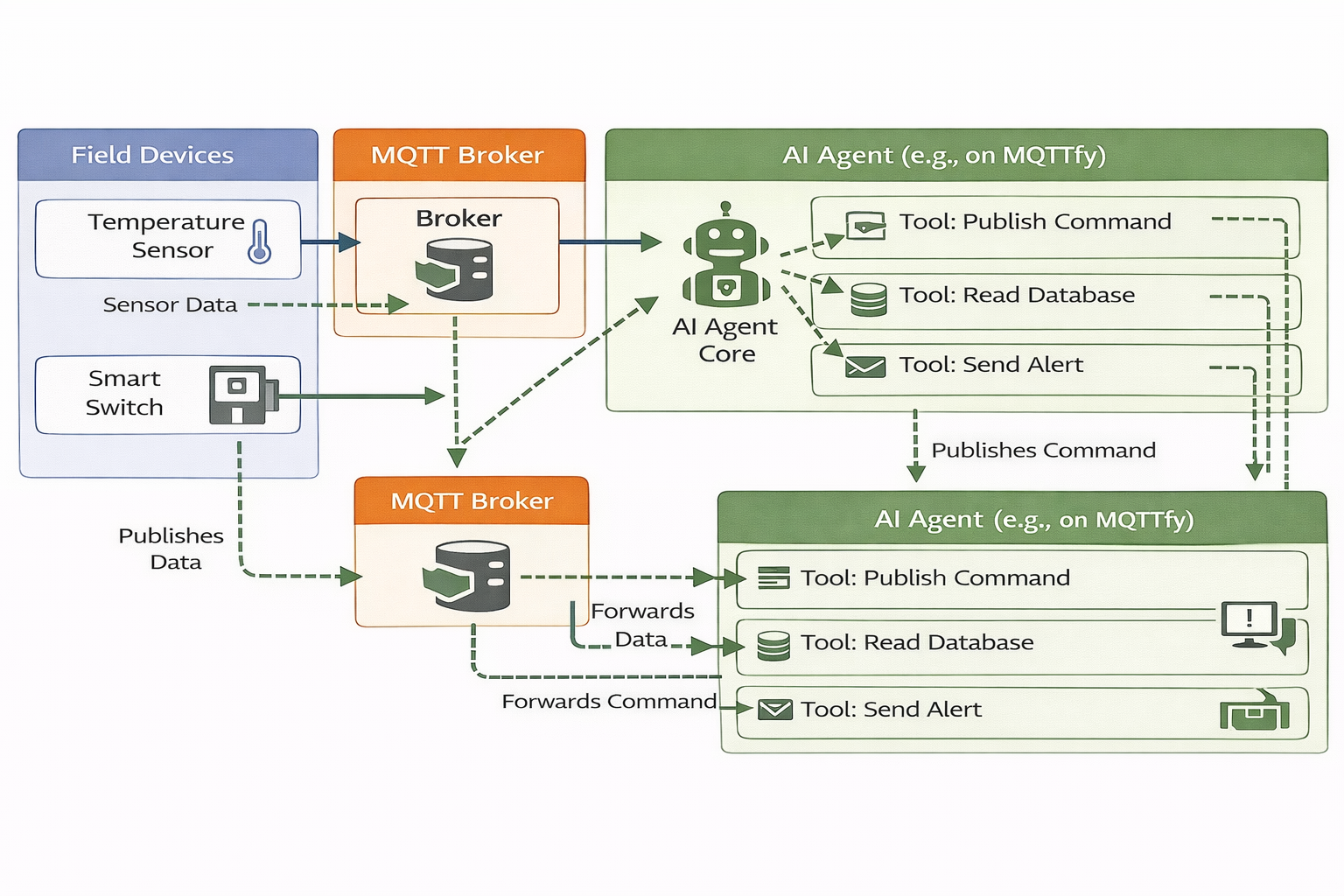
In this diagram:
- An External System (like a motion sensor) publishes a message to the MQTT Broker.
- The AI Agent, which is subscribed to that topic, is triggered by the broker.
- The agent's AI core reasons about the trigger. It consults its goal and its available tools.
- It decides the correct action is to turn on a light. It selects its MQTT Publish Tool.
- The agent invokes the tool, publishing a new message to a different topic (
home/lights/command) with a specific payload (e.g.,{"state": "ON"}). - The Light Controller, subscribed to the command topic, receives the message and turns on the light.
This bidirectional capability is what separates a truly intelligent agent from a simple automation script.
Topic Design and Payload Structure: The Developer's Responsibility
While an agent can be smart, its intelligence is constrained by the quality of the data it receives. As the developer, your most important job is to design a clear and consistent topic structure and payload format.
Best Practices for Topic Design
- Be Specific and Hierarchical: Start broad and get specific.
building/floor_3/room_301/temperatureis better thantemp_301. - Use Consistent Naming: Pick a convention and stick to it (e.g.,
snake_caseorcamelCase). - Separate
statusfromcommand: This is a critical pattern for AI agents..../light/status: This is for the light to report its current state (e.g.,{"state": "OFF", "brightness": 50}). The agent subscribes to this to perceive the world..../light/command: This is for controlling the light. The agent publishes to this to act upon the world (e.g.,{"state": "ON", "brightness": 100}).
Payload Format: JSON is Your Friend
While MQTT can carry any payload (binary, plain text), using structured JSON is almost always the best choice for interoperability with AI agents.
Bad Payload (Plain Text): 25.5
- What is this? Temperature? Humidity? An agent has no context.
Good Payload (JSON):
{
  "value": 25.5,
  "unit": "celsius",
  "timestamp": "2024-06-14T12:00:00Z"
}
- This is self-describing. An AI agent can parse this and understand the meaning of the data without ambiguity. It can use the
unitto perform conversions or thetimestampto check for data freshness.
Example: Building a Basic AI Thermostat Agent
Let's tie this together with a simple example using MQTTfy.
Goal: Create an agent that maintains a room temperature of 22°C.
MQTT Topics:
- Status Topic:
home/thermostat/status(The agent subscribes to this) - Command Topic:
home/thermostat/command(The agent publishes to this)
Agent System Prompt:
"You are a thermostat controller AI. Your goal is to maintain the room temperature at 22°C. You will be triggered by messages on the
home/thermostat/statustopic. This topic provides the current temperature in a JSON payload like{'temperature': 23.5}. If the temperature is above 22°C, you must publish a command to thehome/thermostat/commandtopic to turn on the AC. If it is below 22°C, turn on the heat. The command payload should be{'system': 'cool'}or{'system': 'heat'}."
Agent Tools:
- An MQTT Publish tool configured for the
home/thermostat/commandtopic.
Workflow:
- A sensor publishes
{"temperature": 23.5}tohome/thermostat/status. - The agent is triggered.
- The agent's AI core analyzes its goal and the incoming data (23.5 > 22).
- It decides to use the MQTT Publish tool.
- It constructs the message payload
{"system": "cool"}and publishes it tohome/thermostat/command. - The HVAC system, subscribed to this topic, receives the command and turns on the air conditioning.
Conclusion
For an AI Agent developer, MQTT is more than just a protocol; it's a fundamental building block for creating agents that can perceive and influence the physical world. By mastering the concepts of topic design, payload structure, and the bidirectional publish/subscribe model, you can provide your agents with the sensory and motor skills they need to perform complex, autonomous tasks. The clarity of your MQTT architecture will directly translate to the intelligence and capability of your AI agents.